English
 русский
 Español
 عربى

HUNTACE HUNTACE HUNTACE HUNTACE HUNTACE
HUNTACE HUNTACE HUNTACE HUNTACE


Maintaining a firearm bore is an important part of responsible ownership, storage, and long-term equipment care. A clean barrel helps preserve accuracy, supports reliable operation, and allows the user to inspect the bore for residue, corrosion, or other visible concerns. However, effective bore maintenance requires more than a simple pass with a conventional brush. Carbon, copper, powder residue, lubricant buildup, and other deposits can collect along the internal barrel surface, particularly in areas that are difficult to reach with a rigid or poorly fitted cleaning tool.
The Gun Spring Brush Stainless Steel Bore Cleaner Tool is designed as a professional-grade accessory for deep bore cleaning, residue removal, and polishing support. Its stainless steel wire spiral spring construction combines flexibility with controlled abrasion resistance. This configuration allows the brush to follow the internal contour of the bore while reaching fouling that may remain after ordinary wiping or patching.
Available for multiple rifle, pistol, and shotgun calibers, the brush is intended to support a broad range of firearm maintenance programs. It can be supplied with standard thread configurations, including 8-32 and 5/16-27, allowing compatibility with many cleaning rods already used by firearm owners, gunsmiths, retailers, armorers, and professional maintenance teams.
For distributors, importers, online sellers, and private-label brands, this product also offers practical advantages in SKU management. Multiple caliber options, flexible customization, and OEM or ODM support make it suitable for both standard wholesale programs and customized product lines.
The Gun Spring Brush Stainless Steel Bore Cleaner Tool is a round polishing and cleaning brush developed for firearm barrel maintenance. It uses a coiled stainless steel wire structure rather than a conventional bundle of straight bristles. The spiral form gives the brush a spring-like action, enabling it to flex as it moves through the bore and maintain contact with internal surfaces.
The brush is available for .22cal, .240cal, .30cal, .38cal, .40cal, .45cal, 12GA, 20GA, and .410 bore applications. This selection covers several common rifle and handgun calibers as well as widely used shotgun gauges. Dimensions vary according to the intended caliber, with an overall length range of approximately 60–83mm and bristle lengths ranging from about 34.8–53.8mm.
The product information identifies a standard bristle length of 50mm for one configuration, while the broader product range accommodates different dimensions according to caliber and application. This variation is important because a brush must be correctly matched to the bore. A properly selected brush can create sufficient contact for cleaning without being unnecessarily difficult to pass through the barrel.
The brush is listed under the category of nylon and other material brushes because firearm cleaning programs often group different brush constructions together for retail and catalog purposes. In technical use, this model is distinguished by its stainless steel wire spring construction and its function as a bore cleaning and polishing accessory.
A firearm bore is a precision internal surface. It contains lands and grooves in rifled barrels or a smooth internal passage in many shotgun barrels. These surfaces are exposed to combustion gases, pressure, heat, propellant residue, bullet or shot contact, and environmental contamination. Over time, deposits can build up on the bore surface and may become increasingly difficult to remove.
Loose powder residue can often be removed with patches or a soft mop, but hardened carbon deposits may require mechanical assistance. Copper or other metallic fouling may also adhere to internal surfaces, especially when a firearm is used regularly. A brush helps loosen these materials so that cleaning solvent, patches, and other maintenance tools can remove them more effectively.
A cleaning tool that is too soft may fail to disturb stubborn residue. A tool that is too rigid, poorly sized, or improperly used may create unnecessary wear or make cleaning difficult. The practical value of a spring brush lies in the balance between flexibility and cleaning action. Its coiled form can compress slightly as it enters the bore and expand against the internal wall, producing a more consistent contact pattern than a narrow or uneven tool.
Correct technique remains essential. No brush should be forced through a bore, used with excessive pressure, or selected without checking the intended caliber. The brush is a maintenance accessory, not a substitute for safe handling, proper cleaning chemicals, or manufacturer-approved procedures.
The central feature of this bore cleaner is its stainless steel wire spiral spring construction. Stainless steel is commonly selected for cleaning accessories because it offers corrosion resistance, mechanical strength, and durability in environments where the tool may contact cleaning fluids or remain exposed to moisture during routine use.
The spiral design differs from a straight wire brush or a compact cylindrical bristle bundle. Instead of presenting a fixed, rigid profile, the coiled wire can flex as it travels through the bore. This flexibility supports smoother movement and helps the brush adapt to changes in internal geometry. It is particularly useful when the tool must be guided through a narrow passage while maintaining contact with the bore wall.
The spring structure also supports repeated use. A high-quality cleaning accessory should retain its basic shape through normal maintenance cycles, provided it is used with the correct caliber and stored properly. Stainless steel wire helps the product withstand routine handling, while the simple mechanical design reduces the number of components that could loosen or fail.
The wire handle material is listed as galvanised iron wire. This provides a practical combination of strength and cost efficiency for the connecting section. The working portion is formed as a stainless steel spiral, while the handle and connection structure are produced to support attachment to a compatible cleaning rod.
Compared with low-cost brushes made from untreated wire, the stainless steel construction offers better resistance to surface oxidation. Compared with very rigid cleaning tools, the spring configuration offers greater flexibility. Compared with disposable or highly specialized accessories, it can provide a durable and reusable solution for regular bore maintenance.
One of the principal advantages of the spring construction is its ability to flex during use. A rigid brush may have difficulty maintaining even contact when the barrel surface, tool alignment, or bore diameter varies slightly. The spring form can adapt more naturally to the passage, helping the brush reach a greater portion of the internal surface.
This flexibility is especially valuable when cleaning tools are used by different people with different levels of experience. A brush that moves smoothly and predictably is easier to control than one that catches or binds because of excessive rigidity.
The stainless steel wire provides a stronger mechanical cleaning action than soft cloth alone. It can help loosen carbon buildup, copper fouling, powder residue, and other deposits that remain attached after solvent treatment. Once the residue has been disturbed, patches or mops can be used to carry it out of the barrel.
Mechanical brushing should always be performed with an appropriate solvent and a suitable cleaning procedure. The brush is designed to assist cleaning, not to replace chemical treatment or inspection. Used properly, it can reduce the number of repeated passes required to achieve a satisfactory result.
The product range supports several common firearm sizes. The listed options include .22cal, .240cal, .30cal, .38cal, .40cal, .45cal, 12GA, 20GA, and .410 bore. This broad selection makes the brush suitable for catalog programs serving multiple firearm categories.
For wholesalers, broad coverage can simplify purchasing and product presentation. Instead of sourcing unrelated brush designs from different suppliers, buyers can develop a coordinated range with consistent construction and packaging. For retailers, the range can be organized by caliber or firearm type while maintaining a common product identity.
The brush supports standard thread types, including 8-32 and 5/16-27. These thread configurations are widely used in firearm cleaning accessories, although exact compatibility should always be verified before purchase or use. Thread compatibility allows users to connect the brush to an existing rod, handle, or cleaning system rather than replacing the entire kit.
This feature is also valuable for OEM and private-label buyers. A distributor can specify the thread configuration required for a target market and develop packaging that clearly identifies the appropriate application.
The brush can be included in individual accessory packaging, multi-piece cleaning kits, professional armorer sets, or firearm maintenance bundles. Its compact dimensions make it suitable for storage in a kit case or retail package. It can also be paired with bronze or brass brushes, nylon brushes, cotton mops, patches, cloths, cleaning rods, and adapters.
Because the product uses a straightforward mechanical structure, it is easy to inspect before and after use. Users can check the coil, wire, threaded connection, and overall shape for wear. This supports practical maintenance and helps prevent the use of a damaged accessory.
The manufacturer offers custom specifications for OEM and ODM requirements. Buyers may be able to discuss dimensions, thread standards, packaging, labeling, logo application, and product assortment according to order requirements. This flexibility is important for brands that need a specific visual identity or want to create a complete firearm cleaning range.
A standardized production platform also supports repeat orders. When a buyer has approved a specification, consistent manufacturing procedures can help maintain product uniformity across subsequent batches.
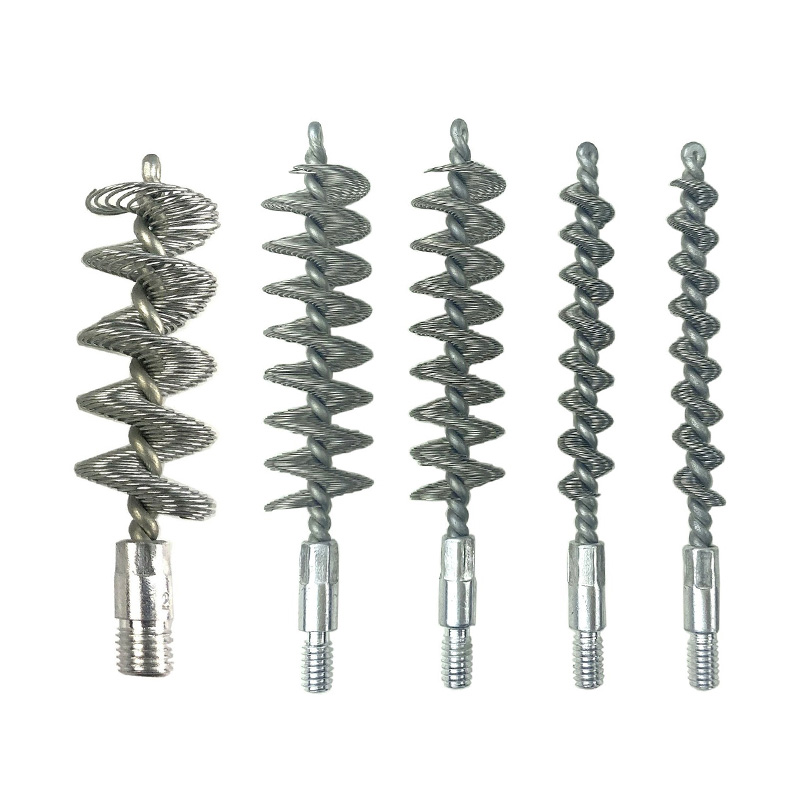
Gun Spring Brush Stainless Steel Bore Cleaner Tool
Rifles often require careful attention to the relationship between the cleaning brush and the rifled bore. Deposits can collect along the lands and grooves, and repeated use may create fouling that is not fully removed by a patch alone. A properly selected spring brush can help loosen residue from these internal surfaces before final patching.
For rifle use, the correct caliber designation is essential. A .22cal brush should not be treated as interchangeable with a .30cal brush simply because both products have similar external lengths. The working diameter and bristle configuration must correspond to the bore size. Users should follow the firearm manufacturer’s cleaning recommendations and confirm that the brush is appropriate before beginning maintenance.
Pistol barrels may accumulate powder residue, bullet material, lubricant, and environmental contamination. A compact bore brush can be useful for routine cleaning after range use or during scheduled maintenance. The available .38cal, .40cal, and .45cal options cover several widely used handgun categories.
The brush’s overall length and threaded connection allow it to be used with a suitable rod or handle. Because pistols often have shorter barrels than rifles, users should maintain control of the rod and avoid allowing the brush or rod tip to strike surfaces unnecessarily. A controlled, straight movement is preferable to excessive force or side loading.
The 12GA, 20GA, and .410 bore options support common shotgun applications. Shotgun barrels may collect powder residue, plastic wad material, lead deposits, dirt, and moisture-related contamination. A correctly sized brush can help loosen material from the barrel before it is removed with patches, cloth, or a bore mop.
Shotgun users should pay attention to the barrel’s internal finish and any manufacturer-specific instructions. A cleaning accessory should be used with an appropriate solvent and at a controlled pace. The brush should never be forced through an obstruction.
The available product dimensions are designed to provide a practical balance between reach, flexibility, and storage efficiency. Depending on the caliber or gauge, total length ranges from approximately 60mm to 83mm. Bristle or working-section length ranges from approximately 34.8mm to 53.8mm.
| Product name | Gun Spring Brush Stainless Steel Bore Cleaner Tool |
| Product category | Nylon and other material brushes |
| Product code | Coil spring brushes |
| Primary function | Firearm bore cleaning and polishing support |
| Working material | Stainless steel wire spiral spring |
| Handle material | Galvanised iron wire |
| Shape | Round |
| Available applications | .22cal, .240cal, .30cal, .38cal, .40cal, .45cal, 12GA, 20GA, and .410 bore |
| Overall length range | Approximately 60–83mm |
| Bristle or working-section length | Approximately 34.8–53.8mm |
| Standard thread options | 8-32 and 5/16-27 |
| Customization | OEM and ODM specifications available |
| Typical sales channels | Wholesale, e-commerce, professional maintenance, and private-label programs |
Dimensions may vary by production specification, bore size, and customer requirement. Buyers should confirm final drawings, thread dimensions, packaging details, and tolerances before placing a production order.
Jinhua Tongshun Tool Factory is a comprehensive manufacturer integrating research and development, production, and sales. Established in 1999, the company has more than 26 years of experience in gun cleaning kits, barrel cleaning brushes, and related maintenance accessories.
This accumulated experience is important in a product category where small dimensional differences can affect usability. Brush diameter, coil tension, wire quality, total length, thread accuracy, and connection strength all contribute to the final user experience. A manufacturer with long-term category knowledge is better positioned to understand how these elements interact.
The factory operates production systems that include semi-automatic and fully automated equipment. Automation can improve repeatability in processes such as wire forming, spring coiling, component assembly, and quantity production. Semi-automatic processes remain useful where product variations, custom dimensions, or inspection requirements call for operator involvement.
A balanced manufacturing system allows the factory to serve both standard catalog orders and customized OEM programs. Standard models can be produced efficiently for regular wholesale demand, while custom products can be adjusted according to customer drawings, market requirements, packaging formats, or branding specifications.
Research and development is integrated with production and sales rather than treated as a separate function. This supports a practical feedback cycle. Product requirements from distributors and end users can be considered during design, manufacturing, and quality evaluation.
For a bore cleaning brush, development may involve evaluating spring structure, wire material, thread format, dimensions, packaging size, and compatibility with related accessories. A product intended for an online marketplace may require different packaging and labeling from one intended for a professional armorer kit. Integrated development makes it easier to respond to these differences.
Semi-automatic and fully automated production systems can help maintain consistent coil shape and repeatable dimensions. Consistency is especially important when a customer orders large quantities for retail distribution. If brush diameters or thread connections vary significantly from one unit to another, returns and customer complaints may increase.
Production consistency also supports visual uniformity for private-label products. Buyers can build confidence when the finish, form, logo placement, and packaging remain stable across repeated orders.
The factory’s production capability is intended to support large-scale orders. This is useful for wholesalers, importers, marketplace sellers, firearm accessory brands, and kit assemblers that require dependable replenishment. A supplier that can handle larger quantities reduces the risk of fragmented sourcing and inconsistent product quality.
Large-order planning should include a confirmed product specification, approved sample, packaging instructions, estimated production schedule, inspection requirements, and shipping plan. Clear communication before production helps protect both the buyer and the manufacturer.
The company exports products to more than 50 countries and regions, with sales coverage including Europe, South America, North America, the Middle East, Asia, and other markets. International experience can help a manufacturer understand differences in packaging, labeling, communication, product documentation, and buyer expectations.
The product is identified as intended exclusively for cross-border export. Buyers should independently confirm the import, sales, labeling, and firearm-accessory regulations that apply in their destination market. The product is a cleaning accessory, but regulatory requirements may still vary by country, platform, or distribution channel.
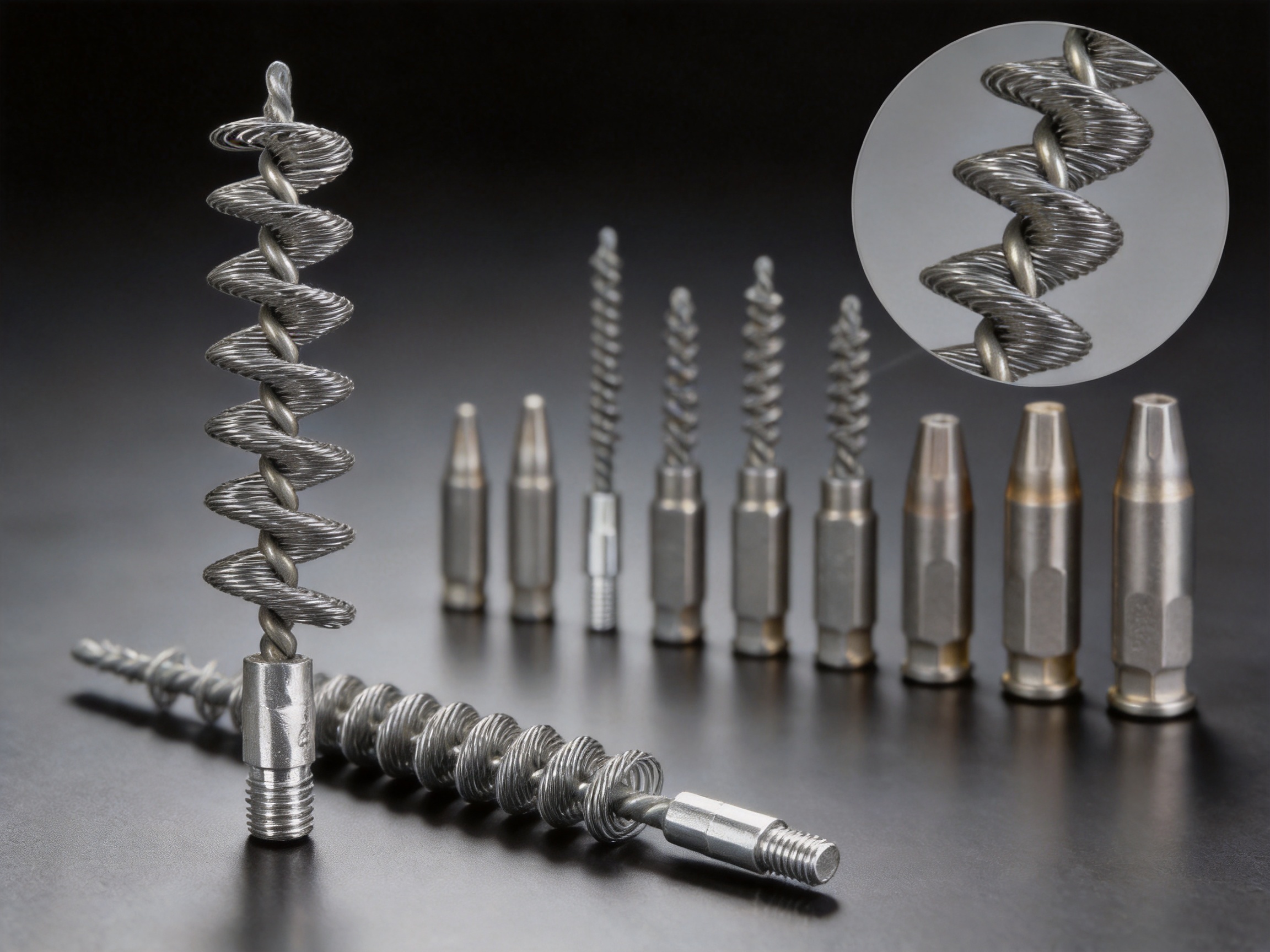
When evaluating bore cleaning brushes, professional buyers should consider more than unit price. The most useful comparison includes material quality, dimensional accuracy, connection strength, surface finish, packaging, order consistency, and after-sales support.
Stainless steel wire should be checked for consistent forming, clean surfaces, and a stable spiral shape. The wire should not show excessive burrs, sharp defects, or irregular deformation. The galvanized iron handle should be securely connected and free from avoidable corrosion or loose sections.
Thread compatibility is a core product requirement. An 8-32 thread and a 5/16-27 thread are not interchangeable, and packaging should clearly identify the supplied version. Buyers should confirm thread dimensions and fit using suitable gauges, reference rods, or approved samples.
Each brush should be clearly marked or packaged according to its intended caliber or gauge. Clear identification reduces the chance of misuse and makes inventory management easier. For e-commerce sellers, accurate product titles, images, variation labels, and technical descriptions can help customers select the correct model.
The brush must remain securely attached to its cleaning rod during normal use. Weak connections can cause the brush to detach in the bore, creating inconvenience and potentially requiring additional tools for removal. Buyers should include connection strength and attachment quality in their sample evaluation process.
Packaging should protect the brush from deformation, moisture, and surface damage during storage and shipment. It should also provide enough information for the customer to identify caliber, thread type, material, and intended use.
For private-label programs, packaging may be customized with a brand name, logo, color scheme, barcode, instructions, and product photography. OEM or ODM packaging can help a distributor create a more complete and recognizable maintenance product line.
Before cleaning, make sure the firearm is unloaded and kept in a safe condition. Remove ammunition from the immediate work area and follow the firearm manufacturer’s safety instructions. The cleaning process should take place in a suitable, well-ventilated location with appropriate personal protection.
Select the brush that matches the firearm’s caliber or gauge. Confirm that the thread type matches the cleaning rod. Inspect the brush for damaged wire, deformation, loose connections, or excessive corrosion before use.
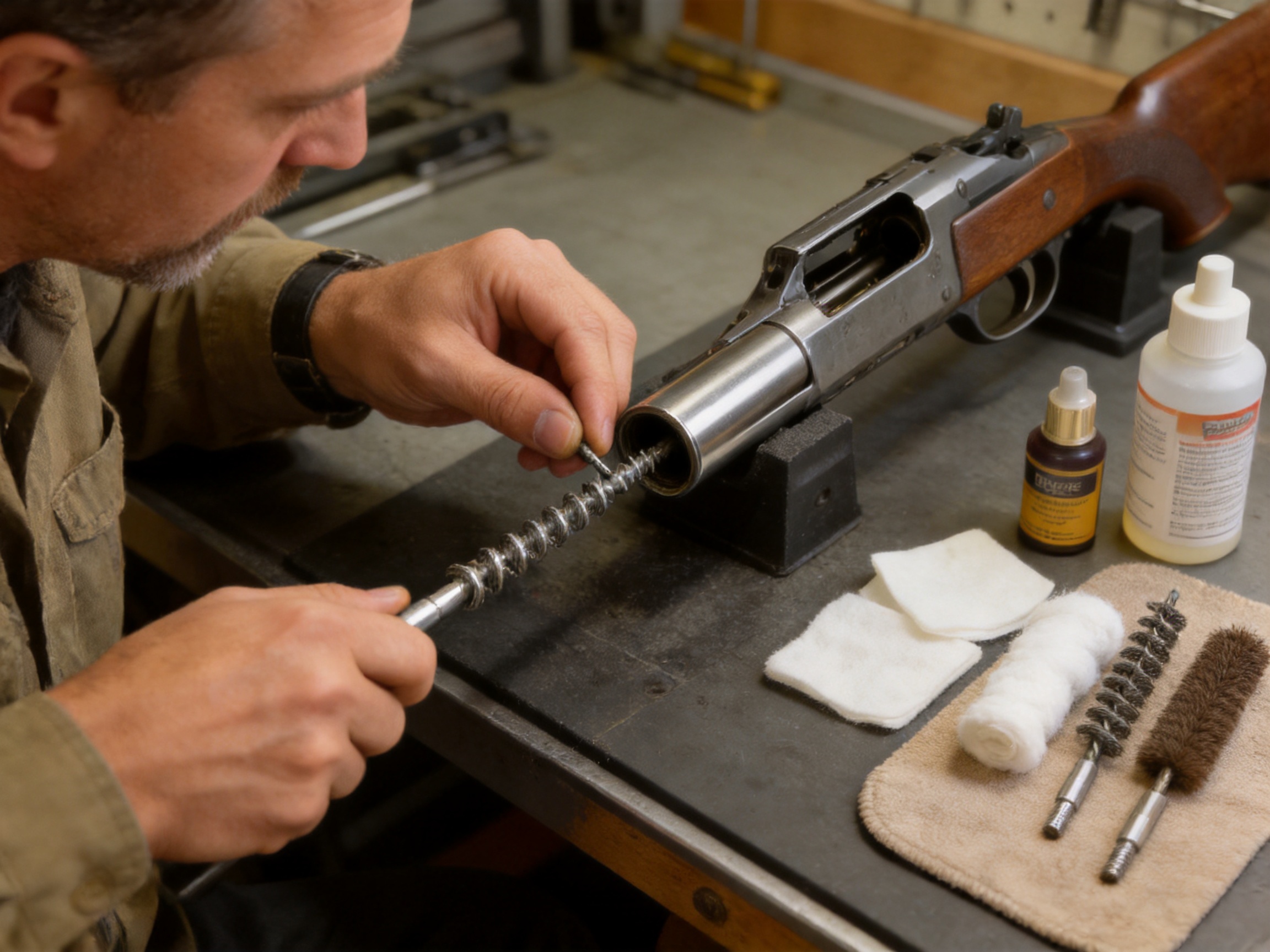
Apply a suitable bore-cleaning solvent according to the solvent manufacturer’s instructions. Attach the brush securely to the rod. Guide the brush into the bore without forcing it. Use controlled passes and avoid bending the rod sharply or applying excessive side pressure.
After brushing, use patches, cloth, or a bore mop to remove loosened residue and excess solvent. Inspect the bore with appropriate lighting when possible. If the brush becomes damaged or its shape changes significantly, replace it rather than continuing to use it.
After use, clean the brush as appropriate, dry it thoroughly, and store it in a dry location. Do not leave the accessory saturated with solvent or exposed to unnecessary moisture. Good storage practices extend service life and help maintain reliable performance.
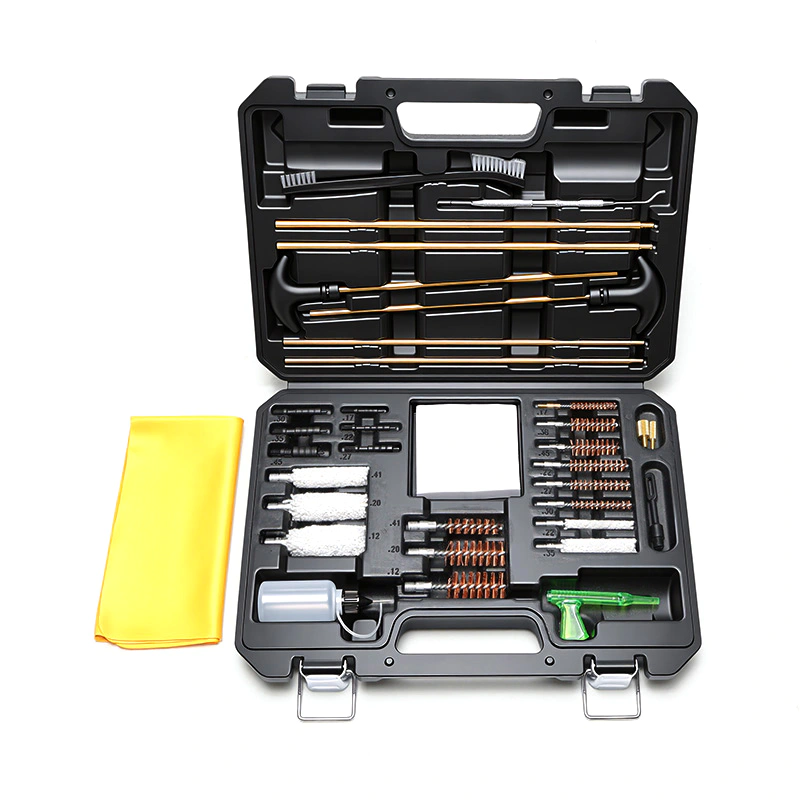
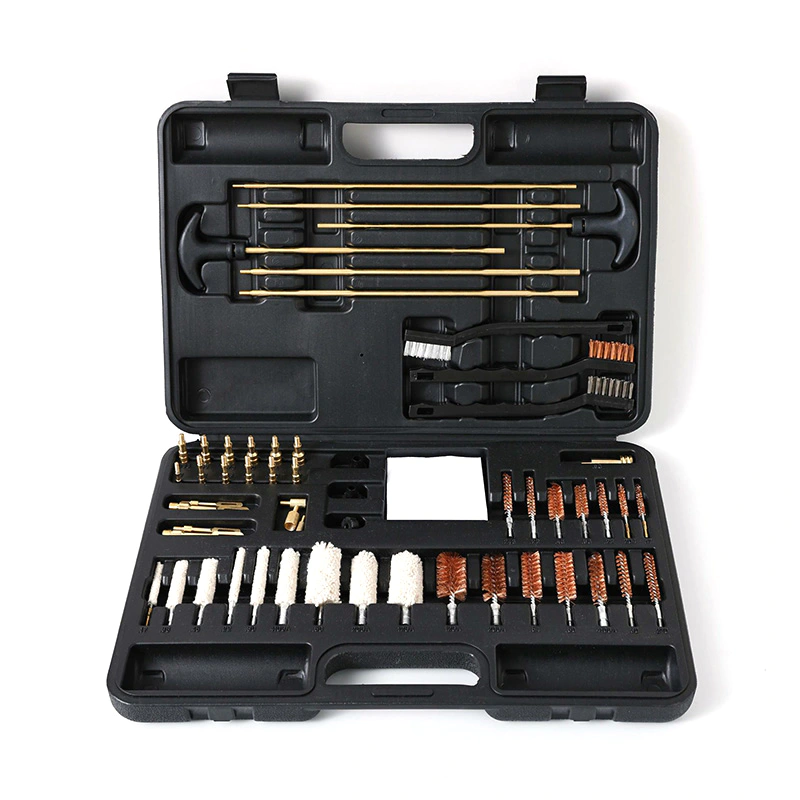
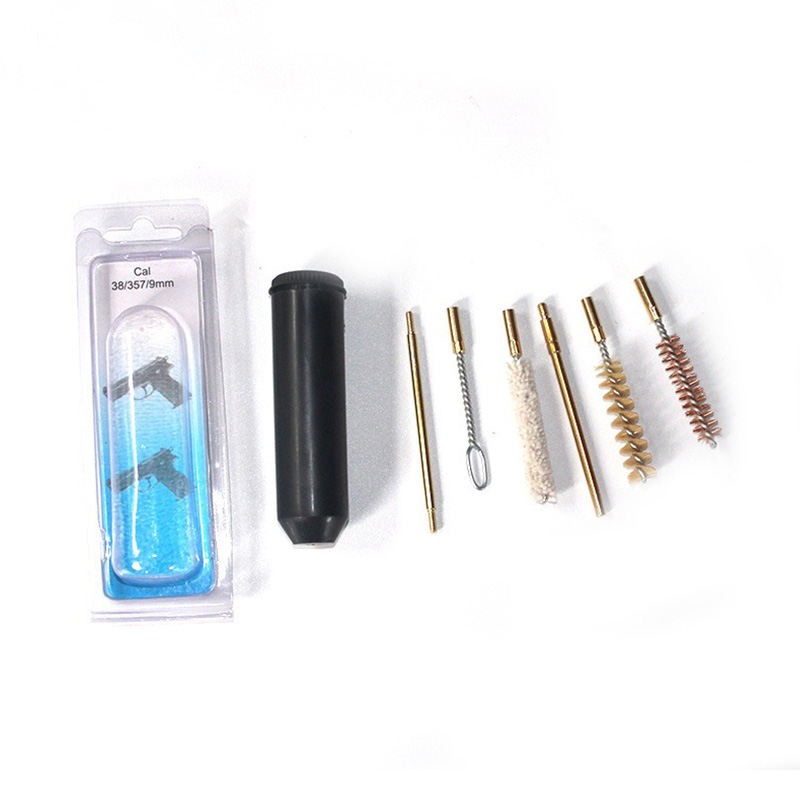
The spring brush is most effective when used as part of a complete maintenance system. A typical system may include a cleaning rod, adapters, solvent, patches, cotton mops, bronze or brass brushes, nylon brushes, and cleaning cloths.
Different accessories serve different functions. A stainless steel spring brush provides mechanical action for loosening stubborn fouling. A bronze or brass brush may be selected for certain cleaning tasks where a different level of stiffness is desired. A nylon brush can assist with lighter residue and general surface cleaning. Cotton mops and patches help remove solvent, loose debris, and final traces of contamination.
By combining tools according to the condition of the bore, users can avoid relying excessively on any single accessory. This approach can also make a cleaning kit more useful for households, shooting clubs, gunsmithing businesses, sporting goods retailers, and professional maintenance programs.
The product’s multi-caliber range creates opportunities for assortment planning. A wholesaler can purchase several variations under one product family, making it easier to present a coherent category to retailers. An online seller can offer caliber-based variations while using common product photography, packaging architecture, and technical language.
The compact format supports efficient storage and shipping. Small cleaning accessories are generally easier to include in mixed cartons, maintenance kits, and replacement-part orders. Their compact size may also reduce packaging complexity, although final shipping efficiency depends on the selected retail package and order quantity.
Another advantage is the possibility of cross-selling. A buyer interested in a spring brush may also require cleaning rods, adapters, patches, cotton mops, brass brushes, bronze brushes, nylon brushes, or complete cleaning kits. A manufacturer that supplies multiple related categories can help distributors build a broader product range.
For sellers operating on Amazon and other e-commerce platforms, accurate variation management is important. Product pages should clearly separate caliber, gauge, thread type, quantity, and packaging options. Technical claims should correspond to the approved specification, and product photographs should represent the actual construction and finish.
Customization can be developed at several levels. The basic product may be adapted by total length, working-section length, wire specification, thread type, caliber range, or connection design. These changes should be discussed through technical drawings and approved samples.
Packaging customization may include printed cartons, header cards, blister packs, polybags, product inserts, multilingual instructions, barcodes, and retail display formats. Logo application and private-label presentation can help a distributor establish a distinct product identity without building a separate factory.
ODM projects may involve the development of a new brush configuration based on a customer’s target market or cleaning kit design. The manufacturer’s experience with barrel cleaning accessories can support discussions about function, production feasibility, and packaging efficiency.
Customers considering customization should provide as much information as possible, including target firearm categories, sales regions, expected annual volume, preferred materials, thread standards, packaging dimensions, compliance requirements, and inspection expectations. Early clarification can reduce delays and minimize the risk of producing a specification that does not meet the intended market.
| Brush type | Typical strength | Typical limitation | Role in a cleaning program |
| Stainless steel spring brush | Flexible structure, durable wire, strong mechanical cleaning action | Requires correct caliber selection and careful handling | Loosening stubborn bore residue and supporting polishing |
| Bronze or brass brush | Effective general-purpose fouling removal with a softer metal construction | May wear more quickly depending on use and cleaning conditions | Routine brushing and removal of common deposits |
| Nylon brush | Gentle cleaning and broad solvent compatibility | May be less effective against hardened deposits | Light cleaning, solvent application, and detail work |
| Cotton mop | Absorbs solvent and removes loose residue | Does not provide strong mechanical scrubbing | Drying, oiling, and final wiping |
| Cleaning patch | Simple, inexpensive, and useful for inspection | Does not conform equally to every bore condition | Removing loosened debris and excess solvent |
This comparison does not mean that one brush type replaces all others. Different materials and forms are useful for different cleaning conditions. The principal advantage of the stainless steel spring model is the combination of flexible geometry, durable wire construction, and broad product availability across common calibers and gauges.
Proper storage is a simple but important part of maintaining a reusable cleaning brush. After cleaning, remove residue and solvent according to the applicable product instructions. Dry the brush before placing it in a sealed container or kit case.
Do not store the brush in a location where it is likely to be crushed, bent, or exposed to persistent humidity. A deformed coil may not move smoothly through the bore and may not maintain the intended contact pattern. For commercial inventory, products should remain in their protective packaging until distribution or use.
Periodic inspection should look for broken wire, flattened coils, loose connections, thread damage, heavy corrosion, and unusual changes in shape. Replacing a worn brush is generally preferable to continuing to use an accessory that no longer performs predictably.
Purchasing from an experienced manufacturer can offer advantages beyond product availability. A factory with a long operating history can provide technical communication, repeat production, multi-category sourcing, and support for customized requirements.
Jinhua Tongshun Tool Factory has specialized in gun cleaning kits, barrel cleaning brushes, and related accessories since 1999. Its integrated R&D, production, and sales structure supports product development from initial concept through manufacturing and export.
The use of semi-automatic and fully automated production systems is suited to a product family that includes both standard and customized models. Automated equipment can support volume and repeatability, while operator-controlled stages can accommodate inspection, assembly, packaging, and customer-specific requirements.
The company’s export experience across more than 50 countries and regions provides a foundation for international wholesale cooperation. Its OEM and ODM services include customized products, packaging, and logos, allowing customers to develop private-label solutions for different markets.
For buyers comparing factories, the most important evaluation should include samples, specification confirmation, communication quality, production capacity, packaging capability, inspection procedures, and delivery performance. An experienced supplier should be able to discuss these issues clearly and provide documentation appropriate to the order.
A professional purchasing process begins with identifying the target application. Buyers should determine whether the product will be sold as an individual brush, included in a multi-piece kit, supplied to a gunsmithing business, or distributed as part of a private-label maintenance range.
The next step is selecting the required caliber and thread variations. If several models are required, buyers should prepare an assortment list showing the quantity, packaging, and labeling for each variation.
Samples should then be evaluated for dimensions, coil uniformity, wire finish, thread fit, connection strength, and packaging quality. The sample approval should be recorded and used as the reference for mass production.
Before confirming an order, buyers should review the commercial specification, logo artwork, packaging files, carton configuration, inspection standard, production schedule, and shipping documents. This preparation improves order clarity and supports stable replenishment.
Its primary purpose is to help clean and polish the internal bore of a firearm. It can loosen carbon buildup, copper fouling, powder residue, and other deposits so they can be removed with patches, cloths, mops, or other cleaning accessories.
The working section uses a stainless steel wire spiral spring construction. The handle material is listed as galvanised iron wire. The combination is designed to provide a durable working tool with a flexible, spring-like form.
The listed options include .22cal, .240cal, .30cal, .38cal, .40cal, .45cal, 12GA, 20GA, and .410 bore. Availability should be confirmed for the specific order and packaging configuration.
The standard thread options include 8-32 and 5/16-27. Buyers should confirm the required thread before ordering because these configurations are different and should not be assumed to be interchangeable.
Yes. Custom specifications are available for OEM and ODM requirements. Potential areas of customization include dimensions, thread type, packaging, product assortment, labeling, and logo presentation, subject to technical and production review.
No cleaning brush should be considered universally suitable without checking the caliber, gauge, thread, and firearm manufacturer’s cleaning instructions. The product covers several common applications, but users must select the correct variation and use it responsibly.
No. It is one component of a cleaning system. Patches, mops, cloths, rods, adapters, solvents, and other brush types may be needed for a complete maintenance process.
Clean and dry the brush after use, then store it in a dry location where the coil will not be crushed or bent. Inspect it before future use and replace it if the wire, connection, or thread is damaged.
The spiral spring form offers greater flexibility and can maintain contact with the bore surface while moving through the barrel. This can help the brush reach residue more consistently than a narrow or highly rigid design, provided the correct size is selected.
Wholesalers, importers, e-commerce sellers, firearm accessory brands, gunsmithing suppliers, kit assemblers, and professional maintenance distributors may purchase the brush in quantity. The factory can discuss standard and customized order requirements.
The product is manufactured by Jinhua Tongshun Tool Factory in Jinhua, Zhejiang, China. The factory address is No. 128, Shigujing, Xiaoshun Town, Jindong District, Jinhua City, Zhejiang Province, P.R. China.
Business inquiries can be directed to Jinhua Tongshun Tool Factory through its sales contact channels. Buyers should provide the desired caliber, gauge, thread type, estimated quantity, packaging requirements, destination market, and whether OEM or ODM customization is needed.
The Gun Spring Brush Stainless Steel Bore Cleaner Tool is a practical and versatile accessory for firearm bore maintenance. Its stainless steel spiral spring construction provides a useful balance of flexibility, durability, and mechanical cleaning action. The design is intended to help loosen stubborn carbon, copper fouling, powder residue, and related deposits while supporting controlled contact with the internal barrel surface.
Its broad selection of rifle, pistol, and shotgun applications makes it suitable for individual users as well as professional and commercial cleaning programs. Standard 8-32 and 5/16-27 thread options support integration with commonly used cleaning rods, while the compact dimensions make the product easy to include in cleaning kits, replacement assortments, and retail packages.
For wholesalers and private-label buyers, the product offers additional value through multi-caliber sourcing, OEM and ODM customization, packaging support, and access to a manufacturer with more than two decades of category experience. Jinhua Tongshun Tool Factory combines R&D, production, sales, semi-automatic systems, fully automated systems, and international export capability to support both standard orders and customized programs.
As with any firearm maintenance accessory, correct sizing and responsible use are essential. When matched to the proper bore and used with an appropriate cleaning procedure, this spring brush can become a durable and effective part of a comprehensive firearm care system.
1. Jinhua Tongshun Tool Factory. Product specification information for the Gun Spring Brush Stainless Steel Bore Cleaner Tool.
2. Jinhua Tongshun Tool Factory. Company profile and manufacturing capability information, established 1999.
3. General firearm maintenance principles concerning bore cleaning, residue removal, inspection, and safe handling.
4. General technical references for stainless steel wire forming, spring construction, galvanized iron wire, and corrosion-resistant cleaning accessories.
5. General product development and quality-control practices for OEM, ODM, wholesale, and private-label tool manufacturing.