English
 русский
 Español
 عربى

HUNTACE HUNTACE HUNTACE HUNTACE HUNTACE
HUNTACE HUNTACE HUNTACE HUNTACE

Keeping narrow channels, tube interiors, spouts, and small mechanical passages clean is often more difficult than cleaning large, open surfaces. Conventional cloths may not enter restricted spaces, rigid metal brushes may scratch sensitive surfaces, and low-quality plastic brushes can lose their shape after only a few uses. The Pipe Wire Brush Rust Removal Spout Cleaner is designed to solve these problems with a compact, reinforced construction that combines a 304 stainless steel twisted core with durable black nylon bristles.
Although the brush is categorized as a nylon and other-material cleaning brush, its design is engineered for demanding industrial, household, equipment-maintenance, and firearm-accessory applications. It can help remove rust residue, limescale, dust, grease deposits, powder residue, and other buildup from narrow passages while offering a less abrasive alternative to all-metal brushes. The result is a practical cleaning tool for distributors, private-label brands, equipment manufacturers, maintenance providers, and online retailers seeking a dependable small-format brush for multiple markets.
The product has a 14.2 mm brush head diameter, a total length of 142 mm, and is intended for channels with an inner diameter of approximately 11.7 mm. Its 1.0 mm stainless steel wire core provides structural stability, while the 0.3 mm nylon bristles are arranged in a reinforced spiral pattern to improve contact with internal surfaces. This combination gives the brush a useful balance between cleaning strength, flexibility, durability, and surface protection.
For buyers comparing similar cleaning tools, the main value of this brush lies in its combination of compact dimensions, material selection, manufacturing flexibility, and OEM/ODM support. It is not limited to one application. The same basic platform can be adapted for pipe cleaning, bottle-spout maintenance, nozzle servicing, industrial detailing, household descaling, and selected firearm-maintenance tasks where a nylon brush is appropriate.
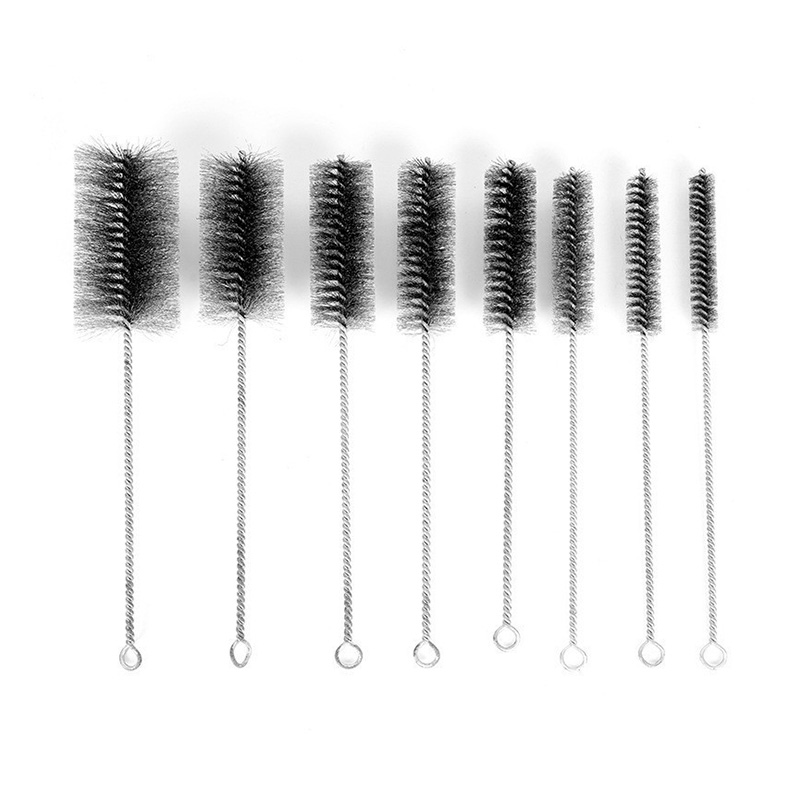
Pipe Wire Brush Rust Removal Spout Cleaner
The Pipe Wire Brush Rust Removal Spout Cleaner is a hand-operated, narrow-channel brush developed for cleaning areas that ordinary brushes cannot reach. Its cylindrical brush head is suitable for the inside of spouts, tubes, small openings, channels, and mechanical components. The brush can be inserted into a passage and moved back and forth to loosen deposits from the internal wall.
The brush is especially useful where access is restricted but the cleaning task still requires physical agitation. Limescale can build up inside water outlets and bottle spouts. Rust residue may collect in small metal tubes and fittings. Dust, grease, and process debris can accumulate inside industrial equipment. Household appliances, laboratory accessories, valves, nozzles, and maintenance components may also require a narrow brush rather than a flat cloth or large cleaning head.
Its nylon bristles are intended to provide cleaning action without the aggressive scraping associated with some uncoated steel brushes. This makes the product a suitable choice for users who need to remove residue while reducing the risk of unnecessary scratching on compatible internal surfaces. The brush should still be tested on the specific material before large-scale use, especially when cleaning polished, coated, painted, plated, or otherwise delicate components.
The 142 mm overall length offers a useful working reach for hand cleaning while remaining compact enough for storage, packing, and high-volume distribution. The 14.2 mm brush head is designed around narrow-channel applications, and the stated 11.7 mm inner-channel compatibility provides a practical dimensional reference for purchasing and engineering teams.
Because the product is supplied as a single brush, distributors can sell it as an individual maintenance accessory, include it in a cleaning set, or bundle it with other tools. It can also be packed in bulk cartons for industrial customers, retail blister packaging for consumer markets, or customized kits for specific equipment and maintenance applications.
The core uses 1.0 mm 304 stainless steel wire. This material provides the foundation of the brush and supports the bristles during insertion, rotation, and reciprocating movement. A twisted-wire core is commonly used in cylindrical cleaning brushes because it holds the bristle material securely while allowing the brush to maintain a compact, flexible profile.
304 stainless steel is widely used in cleaning tools and general industrial components because of its balance of corrosion resistance, strength, availability, and processability. In applications involving water, light chemical exposure, household descaling, or humid storage conditions, stainless steel can offer a practical advantage over ordinary untreated carbon steel. It is not immune to corrosion under all conditions, but it is a suitable and widely recognized material for many general-purpose cleaning environments.
The 1.0 mm core specification also gives buyers a clear basis for quality control. OEM customers can use this dimension when preparing technical drawings, sample approval documents, inspection standards, or packaging specifications. If a different stiffness or level of flexibility is required, the manufacturer can discuss alternative wire materials and structures, including galvanized steel or brass, subject to application requirements and order conditions.
The brush uses 0.3 mm black nylon bristles. Nylon is valued in cleaning applications because it combines flexibility, resilience, and relatively low surface aggressiveness. Compared with many metal bristles, nylon is less likely to leave metallic marks or cause harsh abrasion on compatible surfaces. It can therefore be considered when cleaning painted, coated, plastic, stainless steel, aluminum, or other surfaces where a softer contact material is preferred.
The bristle diameter affects both cleaning feel and flexibility. At 0.3 mm, the filament is fine enough to enter small surface irregularities and internal edges while remaining sufficiently robust for repeated hand use. The exact service life will depend on the material being cleaned, the amount of pressure applied, the presence of chemicals, the frequency of use, and storage conditions.
The black color provides a practical appearance for industrial and maintenance products. It can help conceal ordinary discoloration from dust and residue during use, while also creating a consistent visual identity for private-label packaging. Color changes can be considered for customized product lines when a buyer needs a particular brand presentation or application color code.
The spiral arrangement of the bristles helps create a continuous cleaning surface around the cylindrical core. When the brush moves through a tube or spout, the bristles can contact multiple sides of the internal wall instead of concentrating all cleaning action in one direction. This makes the brush more effective than a simple straight filament inserted into a channel.
The twisted structure also supports bristle retention. A well-formed spiral core helps hold the nylon filaments in place and reduces the chance of premature bristle loss during normal handling. Manufacturing consistency is important because uneven winding, loose bristles, sharp wire ends, or inconsistent brush diameter can affect insertion, cleaning performance, and user safety.
For industrial buyers, the construction offers a useful compromise between rigid and flexible cleaning tools. A fully rigid rod may be difficult to guide through a curved or slightly misaligned passage, while a very soft brush may collapse during insertion. The stainless steel core supplies guidance and support, and the nylon filament provides the surface contact.
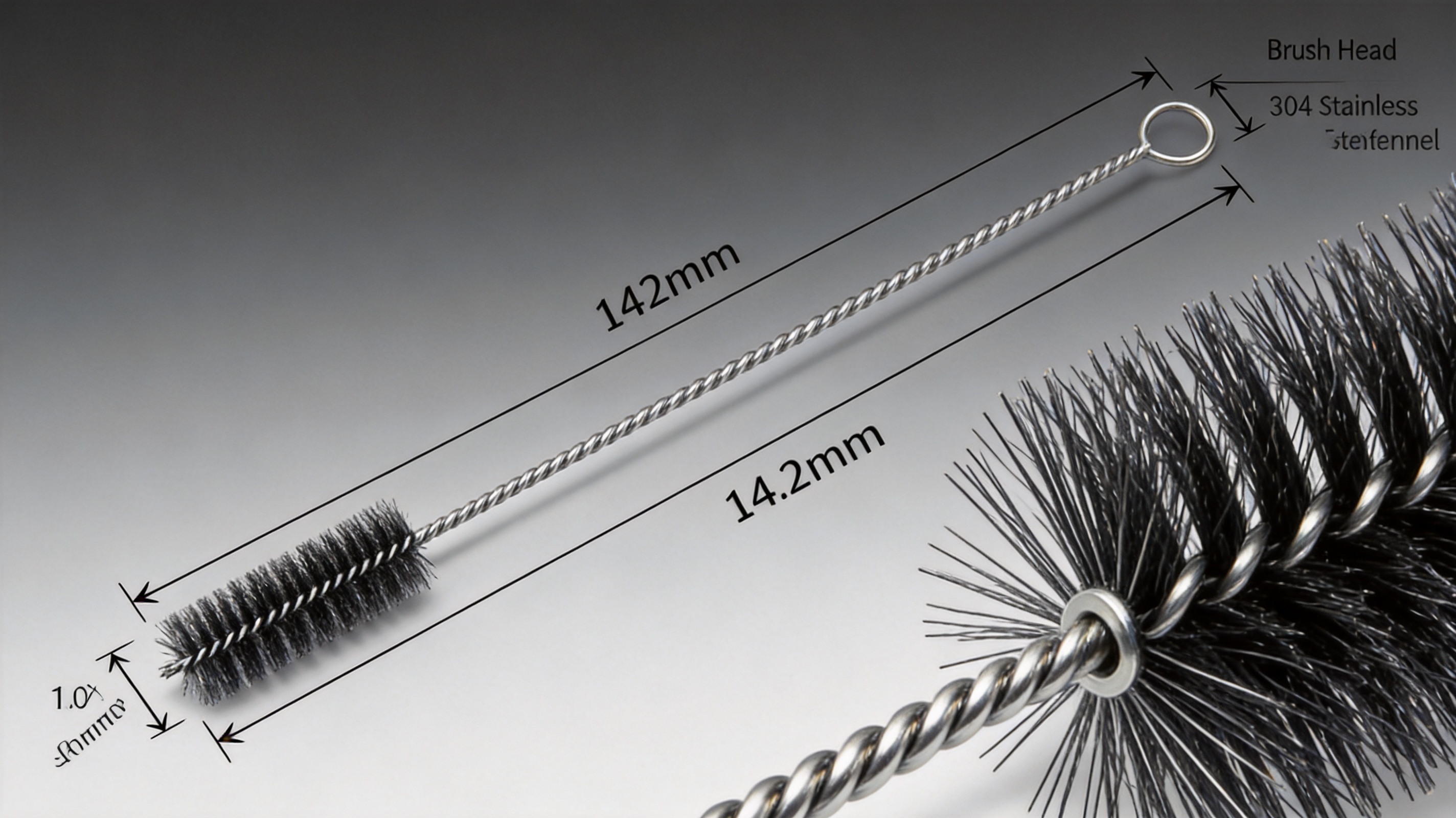
The following specifications summarize the standard product configuration supplied for this cleaning brush. Buyers should confirm final dimensions, tolerances, packaging, and customization details with the manufacturer before placing a production order.
| Specification | Standard Configuration | Practical Significance |
|---|---|---|
| Product type | Nylon pipe wire brush | Designed for internal cleaning of narrow channels and openings |
| Primary function | Cleaning and residue removal | Suitable for deposits such as limescale, rust residue, dust, and grease |
| Brush head diameter | 14.2 mm | Provides a defined working size for compatible passages |
| Recommended inner-channel reference | Approximately 11.7 mm | Helps buyers evaluate fit before ordering |
| Total length | 142 mm | Offers a compact hand-held working reach |
| Core material | 304 stainless steel | Provides support and useful corrosion resistance |
| Core wire diameter | 1.0 mm | Contributes to rigidity, stability, and brush retention |
| Bristle material | Nylon | Offers flexible, relatively non-abrasive cleaning contact |
| Bristle diameter | 0.3 mm | Balances reach into surface irregularities and flexibility |
| Bristle color | Black | Provides a professional appearance for industrial and retail use |
| Standard quantity | 1 brush | Suitable for individual sale or inclusion in cleaning kits |
| Reference weight | Approximately 10 g | Supports economical shipping and compact packaging |
| Standard bulk quantity | 200 pieces per box | Suitable for wholesalers and high-volume distribution |
Dimensional compatibility should always be evaluated before use. The stated brush head diameter and channel reference are important purchasing details, but actual fit may also depend on channel shape, internal obstructions, residue thickness, surface roughness, and whether the brush must pass through a bend. A trial sample is recommended for specialized equipment or precision applications.
All-metal brushes can provide aggressive cleaning action, but they may be unnecessarily harsh for coated, polished, plated, plastic, or soft metal surfaces. Metal bristles can also leave visible marks or introduce loose metal fragments into a component. The nylon bristle design of this product provides a less abrasive alternative for applications where the user wants mechanical cleaning without maximum surface aggression.
The stainless steel core still provides useful support, so the product is not simply a soft plastic filament tool. It combines a stable internal structure with a gentler cleaning exterior. This balance can be valuable when residue must be loosened from a passage but the underlying surface should be protected as much as practical.
Low-cost plastic brushes often have a molded handle and short, loosely arranged bristles. They may be convenient for simple household tasks, but they can lack the reach, cylindrical geometry, or bristle retention required for narrow industrial channels. The twisted stainless steel core in this product gives it a more specialized structure and allows the brush head to enter spaces that a conventional flat plastic brush cannot reach.
The spiral configuration also creates more consistent circumferential contact. Instead of relying on a few fixed bristle rows, the user receives a working surface distributed around the core. This can improve cleaning efficiency when the brush is rotated or moved back and forth through an opening.
Cotton swabs and cloths are useful for wiping accessible surfaces, but they are less suitable for removing firm deposits from narrow passages. They may leave fibers behind, compress during insertion, or fail to reach the full internal wall. The wire brush structure provides mechanical agitation that can break up residue more effectively than a passive wiping material.
The brush can complement, rather than replace, cotton mops, patches, and cloths. For example, a user may first loosen residue with the nylon brush and then use a suitable cloth, patch, or compressed-air procedure to remove remaining particles. In this way, the brush becomes part of a complete maintenance workflow.
A brush with a larger head may clean open surfaces quickly but cannot enter narrow fittings, small spouts, or restricted tube interiors. The compact 14.2 mm head is aimed at the opposite requirement: reaching a defined internal space with a tool that is easy to store and distribute.
For distributors, this focused design can create additional product opportunities. A narrow-channel brush can be sold as a specialty accessory rather than competing directly with large general-purpose scrub brushes. It may also be added to maintenance kits where different brush diameters are required for different openings.
The principal cleaning mechanism is controlled mechanical contact. As the brush is pushed, pulled, or rotated, the nylon bristles press against the interior wall and loosen deposits. The spiral arrangement helps distribute contact around the passage, while the flexible filaments can conform to small irregularities and curved areas.
For limescale and mineral deposits, the brush can help break up buildup before rinsing or applying an approved descaling solution. For rust residue, it can remove loose or partially attached particles from compatible metal passages. For grease and general debris, the bristles provide agitation that can improve the effectiveness of a suitable cleaning agent.
The brush is not a chemical replacement and should not be expected to remove every hardened deposit through dry brushing alone. Severely bonded scale, heavy corrosion, or blocked passages may require soaking, chemical treatment, flushing, or professional maintenance. The brush is best understood as a durable mechanical cleaning aid that improves access and agitation.
Its dimensions also support repeatable maintenance procedures. A service department can specify the same brush for a defined group of tubes or fittings, establish a standard number of cleaning passes, and inspect the brush after use. Consistent tool selection can simplify training, purchasing, inventory control, and quality documentation.
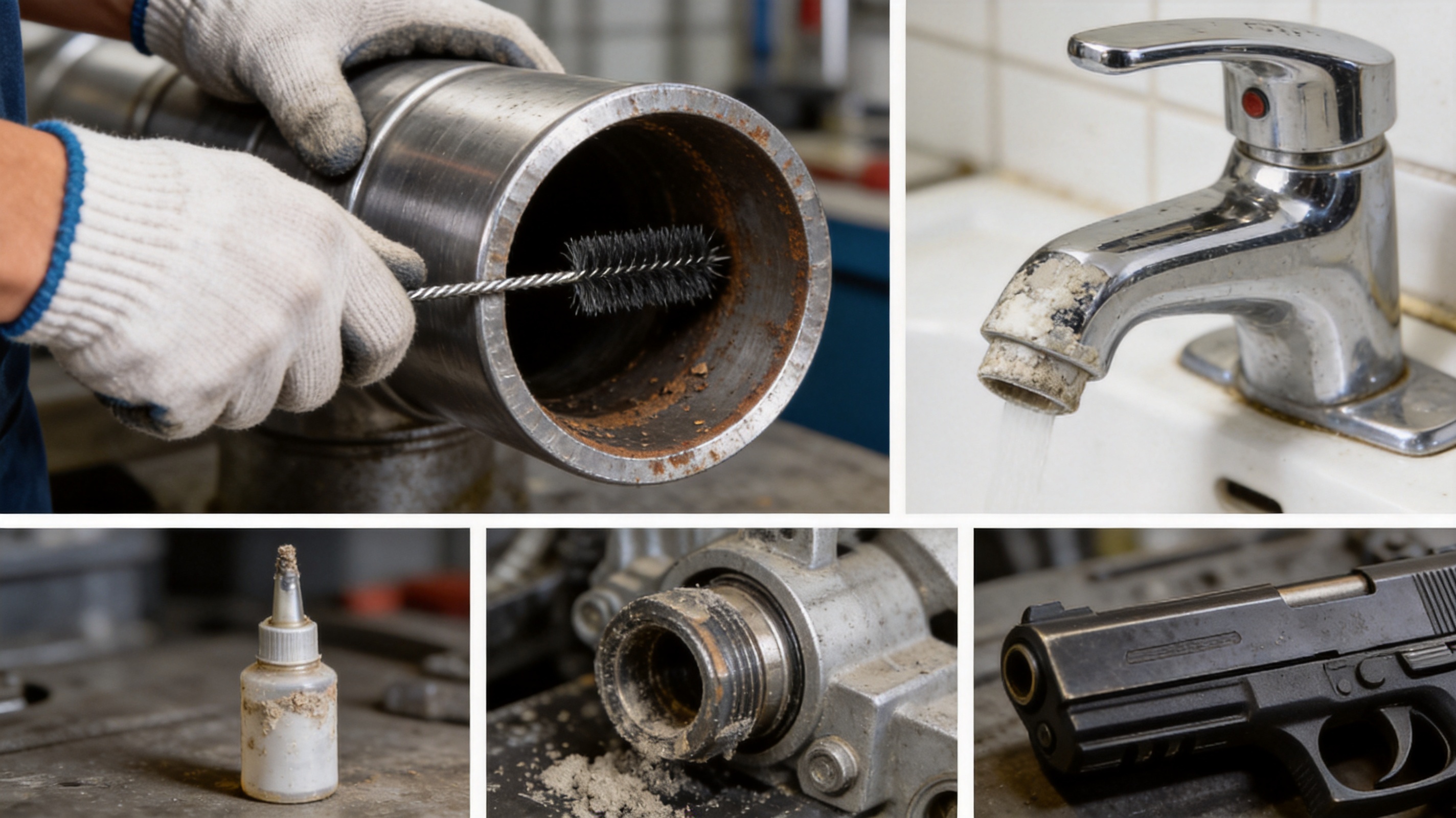
The most direct application is cleaning the interior of small pipes and tubes. The brush can be used to remove loose particles, residue, scale, and light corrosion from passages that are too narrow for a conventional hand brush. It is suitable for maintenance workshops, equipment servicing, plumbing-related tasks, and general industrial cleaning when the passage dimensions are compatible.
Bottle spouts, dispensing outlets, spray nozzles, and small fluid openings can collect dried product, mineral deposits, and dust. The narrow cylindrical brush can reach into these areas and help restore unobstructed flow. In food-related or laboratory environments, users should select appropriate cleaning and sanitizing procedures and confirm that the brush materials meet the requirements of the specific application.
Manufacturing equipment often contains grooves, fittings, vent passages, and small channels that are difficult to clean with a cloth. Maintenance personnel can use the brush for detail cleaning during scheduled servicing, changeovers, and inspection preparation. Its lightweight construction makes it convenient for tool cabinets, mobile maintenance carts, and spare-parts inventories.
At home, the brush may be used for compatible faucet outlets, bottle components, small appliance openings, reusable containers, and other narrow areas where mineral buildup is common. Users should follow the instructions for the appliance or component and avoid forcing the brush into a passage that is too small.
Because the supplier specializes in firearm cleaning tools, this nylon brush may be considered for selected firearm-maintenance accessories and related narrow passages where a nylon brush is appropriate. It can help with light residue and detail cleaning in compatible components, but it should not be treated as a universal bore brush or as a replacement for purpose-designed firearm tools.
Users must verify the correct brush diameter, follow the firearm manufacturer’s maintenance instructions, unload and render the firearm safe before cleaning, and use suitable solvents and lubricants. For firearm applications, material compatibility and dimensional accuracy are particularly important. The brush should never be forced through a passage or used in a manner that could damage a precision surface.
Small fittings, vents, fluid passages, threaded openings, and mechanical channels may benefit from narrow-brush cleaning during repair or refurbishment. The nylon exterior can be considered when the user wants to minimize scratching on compatible surfaces. Before use, technicians should remove loose debris safely and verify that no bristle or wire fragments can interfere with the component’s operation.
Jinhua Tongshun Tool Factory was established in 1999 and integrates product development, manufacturing, and sales. With more than two decades of experience in gun cleaning kits, barrel cleaning brushes, and related accessories, the company has developed production knowledge relevant to both specialized firearm-maintenance products and general-purpose cleaning tools.
The factory operates semi-automatic and fully automated production systems. For a wire brush, production consistency is important at several stages, including wire preparation, bristle feeding, twisting, trimming, forming, inspection, and packing. Automation can help reduce variation between batches, improve output efficiency, and support stable delivery for larger orders.
A modern production system is particularly valuable for private-label customers. Brand owners require repeatable dimensions, consistent color, stable packaging, and predictable replenishment. When the brush is included in a larger kit, even small changes in diameter or length can affect the fit of the packaging tray or the performance of the complete set. Controlled manufacturing helps reduce such supply-chain risks.
The company’s production capability also supports large-scale orders for distributors and cross-border sellers. Its products are exported to more than 50 countries and regions, providing experience with international order coordination, packaging requirements, and product customization. Buyers can discuss product specifications, packaging formats, logo requirements, and shipment arrangements according to their target market.
The quality of a twisted wire brush depends on the relationship between the core wire and the bristle material. If the wire tension is inconsistent, the brush may have uneven density or an irregular diameter. If the bristle feed is unstable, some sections may be sparse while others may be overcrowded. If trimming is inaccurate, the brush may not enter the intended passage smoothly.
Production equipment and operator controls are therefore used to maintain the designed structure. Key inspection points may include core wire diameter, bristle filament diameter, overall length, brush head diameter, bristle distribution, wire-end condition, and general appearance. Buyers with specialized requirements can establish sample approval standards and inspection criteria before mass production.
The standard product uses a 304 stainless steel core and black nylon bristles, but the manufacturer offers broader customization options for OEM and ODM projects. These options may include customized brush diameters, different wire core materials, alternative bristle stiffness levels, and modified handle structures.
Available core-material directions include stainless steel, galvanized steel, and brass. The best option depends on the intended environment, corrosion requirements, flexibility, appearance, cost target, and compatibility with the application. Bristle material and stiffness can also be adjusted when a buyer needs a softer detailing brush, a firmer cleaning tool, or a product optimized for a particular channel.
Handle structures can be customized to improve comfort, grip, storage, or compatibility with a larger kit. A simple wire-end design may be sufficient for industrial bulk sales, while a consumer product may benefit from a molded handle, hanging loop, color-coded grip, or ergonomic structure. The final design should be selected according to the expected user and cleaning method.
The brush is well suited to B2B buyers that want to create a branded cleaning accessory without developing every manufacturing process independently. OEM service allows the buyer to specify the product configuration and apply its own brand identity. ODM service can provide a starting design that is then adjusted for a specific market, package, or application.
Private-label options may include laser logo marking, printed packaging, barcode labeling, custom product inserts, and branded cartons. These services allow distributors to create a consistent presentation across a range of cleaning brushes, gun-cleaning accessories, and maintenance kits.
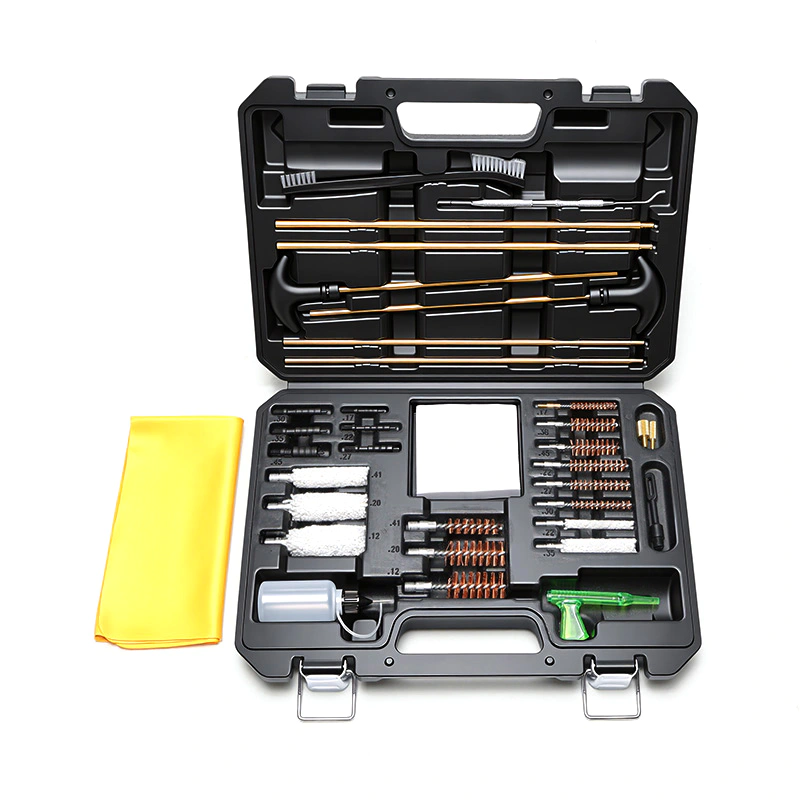
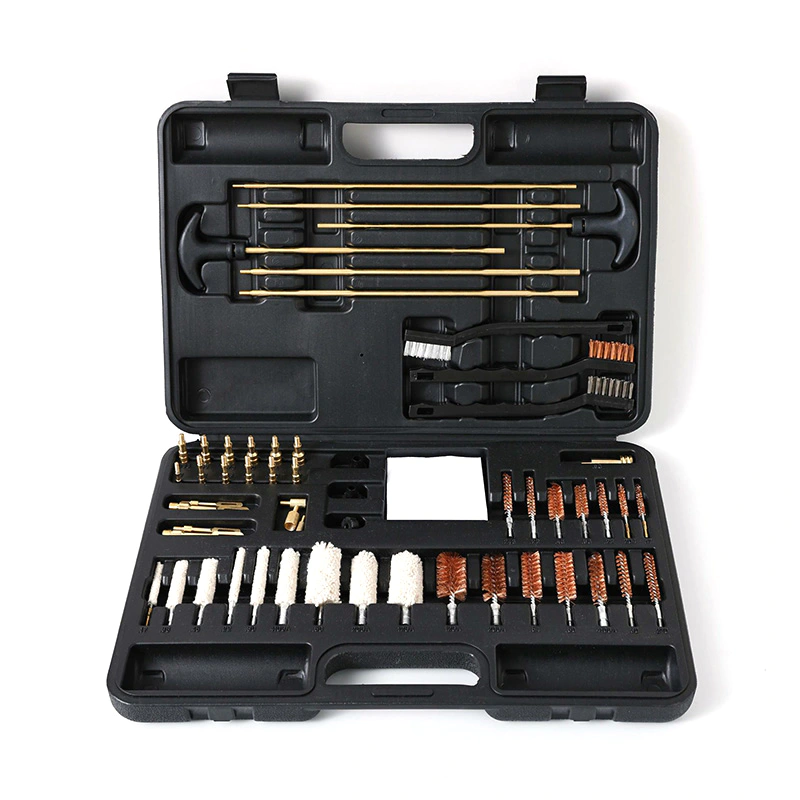
Several packaging formats are available for different sales channels. Bulk cartons are efficient for industrial customers and wholesalers. Retail blister packs can improve shelf presentation and product visibility. Industrial kits can combine the brush with cleaning rods, adapters, patches, cloths, bronze brushes, brass brushes, or other accessories. FBA-ready packaging solutions can also be discussed for marketplace sellers that require specific labeling, carton, and packaging procedures.
Flexible minimum order quantities can be valuable for growing brands. A smaller initial run allows a buyer to test a product listing, evaluate customer feedback, and confirm market demand before committing to a larger volume. Once sales are established, stable large-scale production can support regular replenishment and broader distribution.
For European, Southeast Asian, and Middle Eastern markets, buyers may also require localized packaging, translated instructions, marketplace barcodes, or specific carton markings. These requirements should be agreed upon during the quotation and sample-approval stages. Clear technical communication helps avoid delays and ensures that the delivered product matches the intended sales channel.
The first step is to measure the opening and internal channel. The 14.2 mm brush head is associated with approximately 11.7 mm inner channels, but buyers should consider the actual geometry of the component. A straight opening may accept a different brush than a passage with a bend, taper, shoulder, or internal obstruction.
The brush should be able to enter without excessive force. Forcing an oversized brush can deform the bristles, bend the core, damage the component, or make removal difficult. If the passage is significantly smaller, a reduced brush diameter should be requested rather than relying on compression alone.
Nylon is generally selected when a less aggressive contact material is preferred, but every application has unique requirements. Painted, plated, polished, coated, plastic, aluminum, and soft metal components should be tested with a sample. A small, hidden area can be used to evaluate whether the brush produces unacceptable marks.
For hardened steel, heavy corrosion, or thick deposits, a brass, bronze, or stainless steel brush may be more suitable. The manufacturer can provide different brush types within its wider product range. Selecting the correct bristle material is more important than choosing the most aggressive brush available.
Bristle stiffness affects cleaning force and flexibility. Softer bristles may be appropriate for delicate surfaces and light residue. Firmer bristles may be preferable for stubborn deposits, provided the surface can tolerate the additional contact. Stiffness can be influenced by filament diameter, material, bristle length, density, and core structure.
The standard 0.3 mm nylon bristle specification provides a balanced starting point for many general-purpose applications. Buyers with unusual requirements should request samples in different configurations and compare insertion force, cleaning performance, recovery after use, and surface effect.
An industrial maintenance customer may prioritize bulk pricing, carton quantity, technical data, and stable supply. A retail customer may prioritize handle comfort, packaging appearance, instructions, and barcode information. An online marketplace seller may need product photography, dimensional details, compliant labeling, and packaging designed for fulfillment operations.
Defining the target channel at the beginning of the project helps determine the most suitable product and packaging configuration. The same brush can be marketed differently, but the product presentation should match customer expectations.
Before cleaning, confirm that the component is disconnected, cool, empty, and safe to handle. For firearm-related use, ensure that the firearm is unloaded and follow all applicable safety procedures and manufacturer instructions. Remove loose debris where possible so that large particles do not become trapped in the passage.
Insert the brush gently into the channel. Use short back-and-forth strokes, and rotate the brush only when the component and application permit rotation. Avoid excessive force, sudden bending, or twisting that could damage the wire core. If a cleaning solution is required, use one that is compatible with the component and the nylon bristles.
After brushing, flush, wipe, or rinse the component according to its material and maintenance procedure. Inspect the passage to confirm that loosened residue has been removed. Inspect the brush for bent wire, damaged bristles, contamination, or separation between the core and bristle bundle.
Clean the brush after use when appropriate. Allow it to dry before storage, especially after contact with water or chemical solutions. Store it in a dry location and avoid prolonged exposure to excessive heat, direct sunlight, or chemicals that may degrade nylon. Replace the brush when the bristles become severely worn, the core becomes distorted, or the brush can no longer perform its intended function.
Users should not use the brush in a passage that is blocked so tightly that removal would be difficult. They should also avoid using it on energized equipment, rotating machinery, or components that could start unexpectedly. Proper handling improves both tool life and operator safety.

At approximately 10 grams per piece, the brush is lightweight and economical to ship. Its compact form allows efficient storage in warehouse bins, maintenance cabinets, retail displays, and fulfillment centers. A standard bulk quantity of 200 pieces per box supports wholesale distribution while helping buyers control handling and inventory costs.
Bulk packaging is appropriate for professional users that purchase brushes as consumable maintenance supplies. Retail packaging can be developed for e-commerce, hardware stores, cleaning-supply distributors, and specialty accessory brands. If the brush is included in a firearm-cleaning kit, packaging can be designed to organize it alongside rods, adapters, mops, patches, cloths, and other brush types.
For cross-border sales, packaging should clearly identify the product, quantity, material, dimensions, intended use, and handling information. Barcodes, carton labels, product inserts, and private-label graphics can be incorporated according to the buyer’s requirements. Marketplace sellers should confirm current fulfillment rules before finalizing the package structure.
The product’s small size also supports mixed-container and mixed-carton purchasing. A distributor can combine this brush with other cleaning accessories to create a broader product range without dedicating excessive warehouse space to one item. This flexibility may be useful for businesses serving both industrial customers and online retail channels.
Distributors often need products that are easy to explain, inexpensive to stock, broadly applicable, and suitable for repeat purchase. This brush meets those requirements through a clear function: cleaning narrow passages. Its material combination is easy to communicate, and its dimensions provide practical information for buyers evaluating fit.
The brush can serve multiple customer groups without requiring entirely different manufacturing platforms. Plumbing and maintenance customers may use it for spouts and tubes. Household customers may use it for descaling and detail cleaning. Equipment technicians may use it for small channels and fittings. Firearm-accessory distributors may include it as a nylon cleaning option within a larger maintenance assortment.
Its OEM and ODM flexibility creates opportunities for market segmentation. One customer may request a softer brush for delicate surfaces. Another may request a firmer version for industrial residue. A third may need a branded kit with multiple diameters. The ability to customize the core, bristles, handle, packaging, and branding can help distributors develop differentiated product lines instead of selling an indistinguishable generic item.
Stable production is another important advantage. The factory’s experience, automated and semi-automated manufacturing systems, and export background provide a foundation for repeat orders. While every project should include product inspection and sample confirmation, established production capability can reduce the risks associated with inconsistent quality and uncertain delivery.
Brand owners can use the brush as a standalone product or as part of a larger maintenance system. A branded narrow-channel brush may strengthen a company’s accessory range and encourage customers to purchase compatible tools from the same brand. It can also be included with equipment that requires routine internal cleaning.
Equipment manufacturers may specify the brush as a recommended service tool for a particular nozzle, fitting, or channel. In this case, the buyer can request a customized diameter, length, bristle stiffness, or handle design that matches the equipment. Clear identification and packaging can help maintenance personnel select the correct tool during service.
For firearm-accessory companies, the product can complement conventional bronze, brass, and nylon bore brushes. It may be positioned as a detail-cleaning or narrow-passage accessory rather than a general replacement for every firearm brush. Accurate application instructions are important so that customers understand where the product is appropriate and how to use it safely.
Before mass production, buyers should approve a physical sample and confirm the key specifications. Inspection points may include overall length, brush head diameter, core wire diameter, filament diameter, bristle density, color, straightness, and attachment security.
The brush should be visually checked for loose bristles, exposed sharp wire ends, uneven trimming, excessive deformation, contamination, and packaging damage. Dimensional tolerances should be agreed upon according to the application. If the brush is designed for a precision passage, a go/no-go gauge or application-specific fitting test may be useful.
Performance testing can include repeated insertion and removal, dry brushing, wet brushing, exposure to the intended cleaning solution, and evaluation of bristle retention. Surface compatibility should be assessed on representative component materials. These tests help buyers determine whether the standard configuration meets their requirements or whether a customized version is necessary.
Packaging inspection should verify the correct quantity, barcode, logo, product description, carton markings, and retail presentation. For export orders, documentation and labeling should be reviewed before shipment. A clear quality agreement can define acceptable limits, inspection procedures, sample retention, and procedures for handling nonconforming goods.
The stainless steel core and nylon bristles are selected for durability and repeated use, which can reduce the need for frequent replacement compared with fragile single-use applicators. Extending service life through proper cleaning and storage can reduce product consumption in routine maintenance operations.
At the end of service life, the mixed-material construction may require appropriate disposal rather than simple material separation. Buyers developing retail packaging should consider efficient packaging dimensions, reduced unnecessary inserts, and clear disposal information where applicable. Environmental requirements vary by market, so brand owners should confirm the relevant rules for their destination countries.
Material selection can also be adjusted for specific applications. Stainless steel, galvanized steel, and brass cores provide different balances of appearance, corrosion behavior, cost, and mechanical performance. Nylon bristles can be specified in different colors or stiffness levels. These options allow a product line to be adapted to practical and market-specific requirements.
Its main purpose is to clean narrow and hard-to-reach areas, including spouts, tube interiors, pipe passages, nozzles, and small mechanical channels. It uses nylon bristles for mechanical residue removal and a stainless steel twisted core for structural support.
The standard model uses a 1.0 mm 304 stainless steel wire core and 0.3 mm black nylon bristles. The core helps maintain shape and stability, while the nylon provides flexible and relatively non-abrasive cleaning contact.
The standard brush head diameter is 14.2 mm, the total length is 142 mm, and the product is intended for approximately 11.7 mm inner channels. Buyers should verify the actual passage dimensions and request a sample for specialized applications.
It can help remove loose rust residue, surface deposits, and particles from compatible internal passages. Heavy corrosion or firmly bonded rust may require chemical treatment, a different brush material, or professional refurbishment.
No cleaning brush is universally safe for every surface. Nylon is generally less abrasive than many metal bristles, but users should test it on the actual material, especially when the surface is polished, painted, coated, plated, plastic, or otherwise delicate.
It may be used for selected firearm-maintenance and detail-cleaning applications when the dimensions and nylon material are appropriate. It is not a universal bore brush. The firearm must be unloaded and handled according to the manufacturer’s instructions and applicable safety requirements.
Yes. OEM and ODM options may include brush diameter, core material, bristle stiffness, handle structure, logo marking, packaging, barcode labels, and kit configuration. Custom specifications should be confirmed through drawings, samples, and written approval.
Possible core materials include stainless steel, galvanized steel, and brass. The selection depends on corrosion resistance, flexibility, appearance, mechanical requirements, cost, and the intended application.
Available formats may include bulk cartons, retail blister packs, industrial cleaning kits, private-label packages, and FBA-ready packaging solutions. The final format should match the sales channel and destination-market requirements.
The listed standard bulk quantity is 200 pieces per box. Buyers should confirm the final packing method, carton dimensions, and quantity for customized orders.
Yes. It can be used for compatible bottle spouts, small appliance openings, faucet outlets, reusable containers, and household descaling tasks. Users should follow appliance instructions and avoid forcing the brush into undersized passages.
After use, clean the brush when appropriate, allow it to dry, and store it in a dry location. Avoid prolonged exposure to excessive heat, direct sunlight, and chemicals that may affect the nylon or stainless steel core.
Buyers should inspect dimensions, bristle density, filament diameter, wire diameter, overall length, straightness, bristle retention, surface condition, packaging, and application performance. A sample approval process is recommended for OEM and private-label projects.
Potential customers include industrial distributors, maintenance companies, household-cleaning brands, plumbing suppliers, equipment manufacturers, firearm-accessory companies, marketplace sellers, and private-label importers.
The Pipe Wire Brush Rust Removal Spout Cleaner is a compact but technically purposeful tool for cleaning narrow internal spaces. Its 304 stainless steel twisted core provides support and durability, while the 0.3 mm nylon bristles deliver flexible cleaning contact with a lower-abrasion profile than many all-metal alternatives. The 14.2 mm brush head, 142 mm overall length, and approximately 11.7 mm channel reference give buyers clear starting points for application evaluation.
Its strongest commercial advantages are versatility, compact logistics, material balance, and customization potential. It can be sold as an individual brush, included in a maintenance kit, or developed as a private-label accessory for industrial, household, equipment, and selected firearm-maintenance markets. Compared with ordinary plastic brushes, it offers a more structured wire-core design. Compared with aggressive metal brushes, it provides a gentler nylon cleaning surface. Compared with cloths and swabs, it offers greater mechanical access and agitation inside restricted channels.
Jinhua Tongshun Tool Factory supports this product with long-term manufacturing experience, semi-automatic and automated production systems, international export capability, and OEM/ODM services. Buyers can request customized dimensions, materials, bristle stiffness, handle styles, branding, packaging, and fulfillment solutions. Through sample approval and application-specific quality control, the standard brush can be adapted to the requirements of distributors, equipment manufacturers, and brand owners seeking a reliable supply partner.
1. Product technical information supplied for the Pipe Wire Brush Rust Removal Spout Cleaner, including dimensions, material specifications, packaging quantity, and application data.
2. General engineering principles for twisted-wire brush construction, nylon filament cleaning tools, and narrow-channel maintenance brushes.
3. General material reference information for 304 stainless steel, nylon bristles, galvanized steel wire, and brass wire used in industrial cleaning-tool manufacture.
4. General maintenance guidance concerning surface compatibility testing, brush inspection, cleaning-tool storage, and safe handling procedures.
5. Manufacturer-provided company information regarding production experience, OEM/ODM services, automated manufacturing systems, export markets, and private-label packaging capability.