English
 русский
 Español
 عربى

HUNTACE HUNTACE HUNTACE HUNTACE HUNTACE
HUNTACE HUNTACE HUNTACE HUNTACE

Cleaning narrow channels is one of the most demanding tasks in maintenance, manufacturing, household care, and equipment servicing. Conventional cloths may not reach internal surfaces, while rigid metal brushes can be too aggressive for delicate passages. A specialized pipe wire brush must therefore combine sufficient structural strength with controlled flexibility, reliable bristle retention, and a size suitable for restricted openings.
The Pipe Wire Brush Rust Removal Spout Cleaner is designed for this exact purpose. It combines a 1.0 mm 304 stainless steel twisted core with 0.3 mm black nylon bristles to create a compact, durable, and versatile cleaning tool. The reinforced spiral construction supports effective removal of rust particles, limescale, residue, and accumulated deposits from bottle spouts, tube interiors, pipe fittings, nozzles, and fine mechanical channels.
With a brush head diameter of approximately 14.2 mm, an overall length of 142 mm, and compatibility with channels around 11.7 mm in diameter, the brush is suited to areas that are too narrow for conventional hand brushes. Its nylon bristles provide firm contact without the harsh scraping action associated with many all-metal alternatives. This balance makes the product useful for distributors, wholesalers, private-label brands, maintenance suppliers, and industrial cleaning product companies.
More than a single finished item, this brush represents a scalable OEM and ODM product platform. The manufacturer can adjust brush dimensions, wire materials, bristle stiffness, handle structures, branding, and packaging to meet different market requirements. Stable production capacity, automated and semi-automatic manufacturing systems, and long-term experience in cleaning tool production support consistent supply for international buyers.
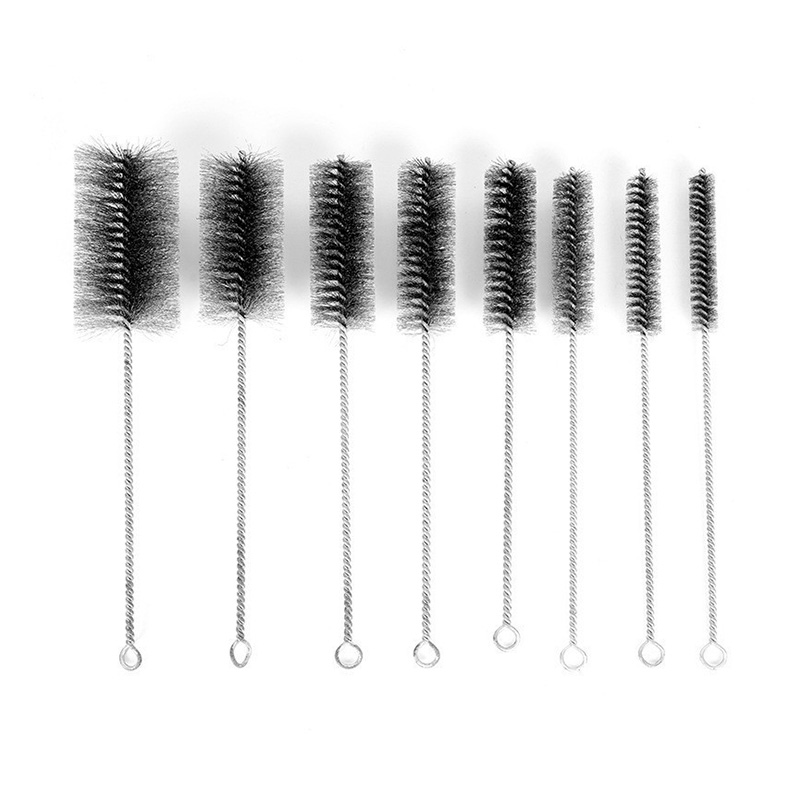
Pipe Wire Brush Rust Removal Spout Cleaner
The Pipe Wire Brush Rust Removal Spout Cleaner is a narrow-channel cleaning brush constructed around a twisted metal wire core. Nylon filaments are secured into the spiral structure, forming a cylindrical brush head capable of entering small openings and contacting internal walls. The design is simple in appearance but depends on accurate material selection and controlled assembly to achieve dependable performance.
The core uses 304 stainless steel wire with a stated diameter of 1.0 mm. This stainless steel grade is widely used where corrosion resistance, mechanical strength, and general durability are important. The twisted core gives the brush its shape and provides a flexible support structure that can bend slightly during use while maintaining enough rigidity for insertion and scrubbing.
The brush filaments are made from black nylon with a diameter of approximately 0.3 mm. Nylon is valued for its resilience, resistance to many common cleaning environments, and relatively gentle contact with surfaces. Compared with a brass or bronze filament, nylon is less likely to leave metallic marks on suitable surfaces. Compared with many soft textile cleaning tools, it provides better mechanical agitation and can dislodge deposits from grooves and internal corners.
The brush head measures approximately 14.2 mm in diameter. Because the nylon filaments can flex during insertion, the brush can serve channels with an inner diameter of around 11.7 mm, subject to the shape, material, and condition of the channel. The overall length is 142 mm, providing a useful reach for spouts, tubes, short pipe sections, and recessed openings without making the tool difficult to control.
The standard product is supplied in black and weighs approximately 10 grams per piece. A typical carton quantity is 200 pieces, and bulk packaging is available. The compact dimensions and low unit weight make the item economical for storage, shipping, retail assortment planning, and online fulfillment programs.
| Product type | Nylon pipe and spout cleaning brush |
| Primary function | Cleaning narrow channels, spouts, tubes, and internal passages |
| Core material | 304 stainless steel |
| Core wire diameter | 1.0 mm |
| Bristle material | Nylon |
| Bristle diameter | 0.3 mm |
| Brush head diameter | Approximately 14.2 mm |
| Overall length | Approximately 142 mm |
| Recommended channel compatibility | Approximately 11.7 mm inner channels, depending on application |
| Colour | Black |
| Approximate unit weight | 10 g |
| Standard quantity per box | 200 pieces |
| Packaging format | Bulk packaging, with customized options available |
| Customization | OEM and ODM dimensions, materials, branding, and packaging |
Material selection is one of the main factors distinguishing a professional cleaning brush from a basic household brush. A filament that is too soft may fail to remove deposits, while a filament that is too hard can damage the surface being cleaned. The 0.3 mm nylon filament used in this product is selected to provide a useful compromise between flexibility, resilience, and cleaning force.
Nylon bristles can bend around the internal profile of a tube or spout. This allows more filaments to remain in contact with the surface as the brush is pushed, pulled, or rotated. The bristles can enter shallow grooves, seams, and irregularities where a flat cloth or rigid scraper cannot make effective contact.
Nylon is also a practical choice for applications involving painted, coated, plastic, stainless steel, or otherwise sensitive surfaces. It does not have the same cutting action as a bare steel brush. When used correctly, it can help reduce the risk of aggressive abrasion while still providing enough friction to loosen scale, residue, dust, and loose corrosion products.
The word “non-abrasive” should always be understood in the context of proper use. Any brush can mark a soft material if excessive force is applied, if abrasive particles become trapped in the bristles, or if the brush is used repeatedly on an unsuitable surface. Nevertheless, nylon is generally a gentler choice than steel for many delicate internal cleaning tasks.
Another benefit is resilience. Nylon filaments are capable of recovering much of their original shape after moderate bending. This is important for a brush that must pass through a restricted opening and then continue to scrub effectively. The filament diameter also influences the cleaning feel: 0.3 mm offers more body than an ultra-fine filament while remaining flexible enough for narrow passages.
The twisted-core structure is central to the product’s durability. Instead of relying on a separate plastic handle and a loosely attached brush head, the brush is formed around a spiral metal support. The 1.0 mm 304 stainless steel wire provides a stable backbone for the bristles and helps the tool resist deformation during normal cleaning operations.
A controlled spiral structure can distribute the bristles along the length of the brush head. This improves coverage and creates a consistent cylindrical profile. It also helps keep the filaments securely positioned when the brush is rotated inside a tube or moved repeatedly through a spout.
The stainless steel core offers several practical advantages for distributors and end users. It is less vulnerable to ordinary moisture exposure than untreated carbon steel, which is important because cleaning brushes are often used around water, detergents, damp equipment, and wet residue. Its mechanical strength also supports repeated handling, storage, packing, and application.
Core construction must be controlled carefully. If the twist is too loose, bristles may not be retained securely. If it is too tight, the brush may become unnecessarily rigid or the nylon may be compressed unevenly. Manufacturing precision therefore affects both the appearance and the working performance of the finished product.
For this reason, the product is not simply a bundle of nylon fibers attached to a wire. It is an engineered combination of filament diameter, core gauge, twist geometry, brush-head diameter, total length, and intended channel size. These factors work together to determine how the brush enters, contacts, and exits a narrow passage.
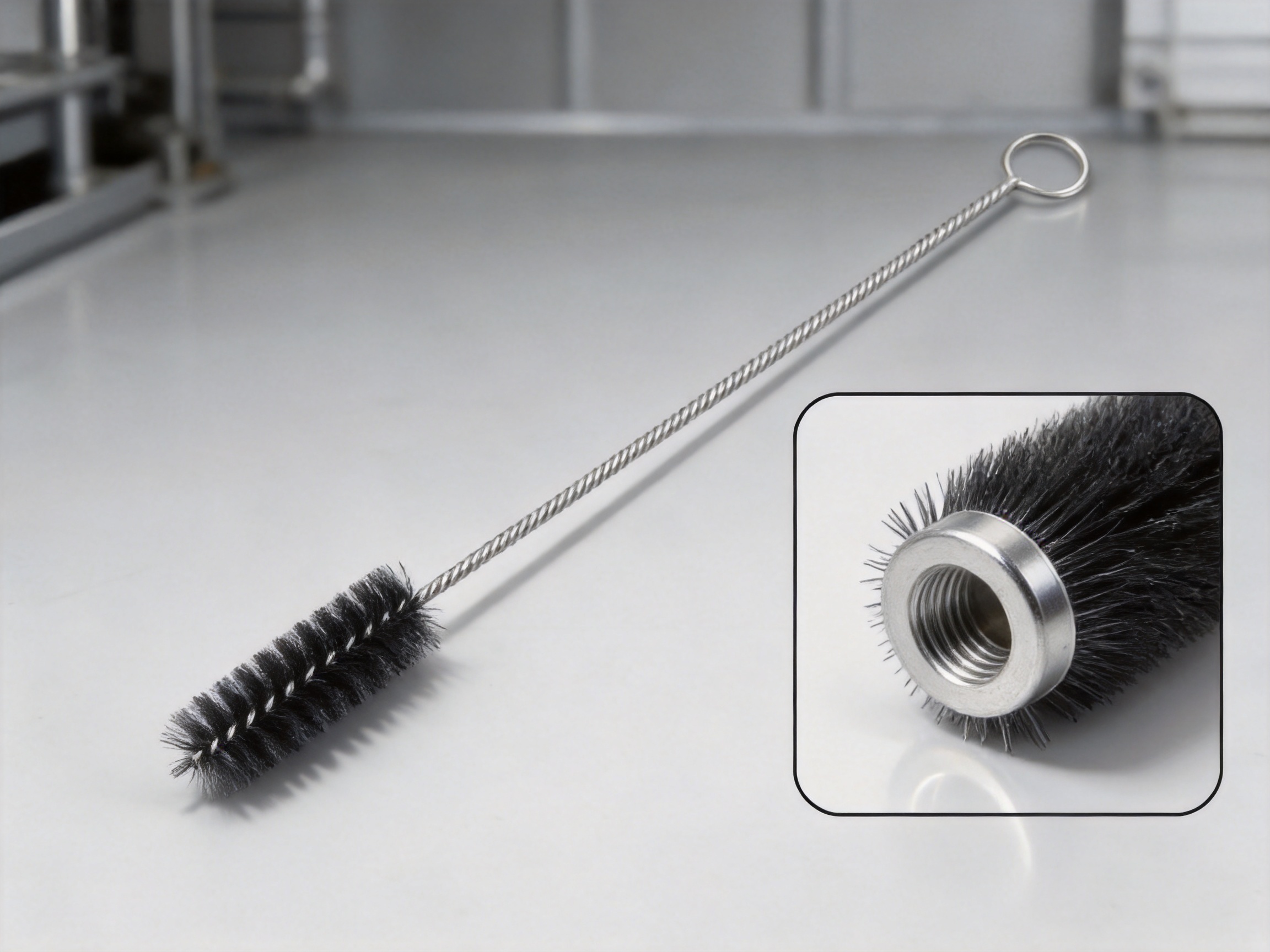
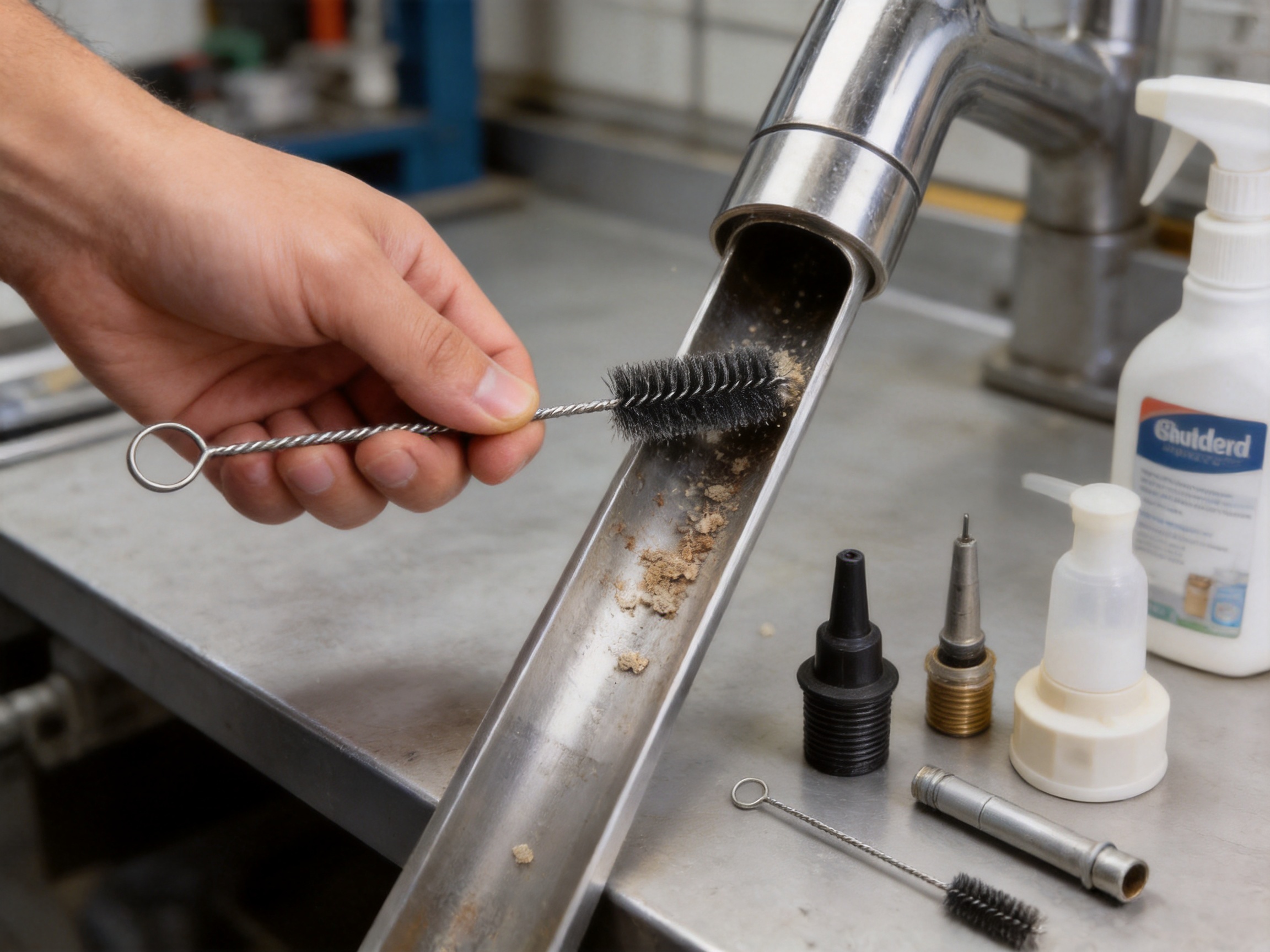
Narrow openings are frequently overlooked during routine maintenance. A bottle spout may collect dried liquid, a nozzle may accumulate mineral residue, and a tube may retain dust or production debris along its inner wall. When these deposits harden, wiping the outside of the component does not solve the problem. The contamination must be physically reached from within.
The Pipe Wire Brush Rust Removal Spout Cleaner provides a direct mechanical method. The user inserts the brush into the opening and moves it back and forth or rotates it gently. The nylon filaments make contact with the internal surface and loosen deposits through repeated brushing action. For heavier buildup, the component can be pre-soaked with a suitable cleaning solution before brushing.
For rust removal, the brush is particularly useful for loose rust flakes, surface oxidation residue, and corrosion-related particles inside compatible channels. It should not be treated as a substitute for chemical rust treatment or heavy abrasive tooling when deep corrosion is present. Its role is to remove accessible residue while minimizing unnecessary damage to the underlying surface.
For limescale and mineral deposits, pre-treatment can improve results. A suitable descaling solution may soften the deposit, after which the nylon brush can reach the softened material and help clear it from the passage. The brush’s cylindrical form allows it to work around the internal circumference rather than cleaning only one side.
For household spouts and equipment nozzles, the 142 mm length offers a useful working reach. It is long enough for many short internal passages but remains compact enough for controlled hand movement. The brush can also be stored in a tool drawer, maintenance kit, cleaning caddy, or retail package without requiring excessive space.
For mechanical channels, the brush can assist with routine detailing. It may be used on suitable tube interiors, small fittings, fluid outlets, equipment recesses, and other areas where loose residue must be removed without using a large rigid brush. The user should always confirm chemical compatibility and dimensional suitability before applying the brush to a specialized component.
All-metal brushes can provide strong scraping power, but they may be unnecessarily aggressive for plastic, painted, coated, polished, or precision-machined surfaces. Metal filaments can leave visible marks or remove surface treatments when excessive pressure is applied. The nylon bristles in this product offer a more controlled cleaning action for applications where surface protection matters.
The stainless steel core still provides structural support, but the surface-contacting material is nylon. This division of function gives the brush a durable internal backbone without making the working bristles as harsh as exposed metal wire. It is a practical configuration for cleaning residue and deposits in channels that require firmness but not severe abrasion.
Cloths, cotton swabs, and foam-tipped tools are convenient for broad or shallow surfaces, but they may not reach the entire internal wall of a narrow passage. Fibers can also bunch up at the opening or fail to provide enough friction against hardened deposits.
The spiral nylon brush creates a defined cylindrical cleaning surface. Its bristles are distributed around the core, allowing the user to scrub the interior rather than simply wiping the entrance. It also offers more mechanical resilience than a disposable swab, which can collapse under pressure.
Molded plastic brushes may be economical, but their shape is often fixed and their reach may be limited. They can be difficult to adapt to different openings, especially when the access point is narrow or angled. The twisted wire core of this product allows a degree of controlled flexibility while maintaining a longer, more useful working profile.
The wire-supported design also enables customization. Buyers can request alternative diameters, lengths, wire materials, bristle stiffness levels, and end configurations. This makes the product easier to adapt for specific retail categories or industrial use cases.
Low-cost brushes may use inconsistent wire, weak bristle retention, uneven twists, or poorly controlled dimensions. These issues can lead to early deformation, filament shedding, or inconsistent cleaning performance. A manufacturer with established production systems can reduce such problems through standardized materials, process control, and inspection procedures.
The use of 304 stainless steel and a defined 0.3 mm nylon specification provides buyers with a clearer product profile. Consistent specifications make it easier to create product listings, packaging information, quality standards, and repeat orders across multiple purchasing cycles.
The product is well suited to bottle spouts, dispenser outlets, small nozzles, and similar components. These areas often collect dried liquids, mineral deposits, and sticky residue. The narrow brush head can enter the opening and clean around the inner circumference.
Restaurants, beverage equipment suppliers, hospitality businesses, and household product distributors may find this type of brush useful as an accessory or replacement cleaning tool. It can also be included in maintenance kits for reusable containers, dispensers, and small fluid-handling equipment.
Small tubes and channels can be difficult to clean with standard brushes because the tool may be too large or too short. The 142 mm length and flexible wire-supported design provide access to many short and medium-depth passages. The brush can be inserted, withdrawn, and rotated according to the geometry of the component.
It is important to distinguish between general cleaning and specialized pipe maintenance. The product is intended for narrow passages and routine residue removal. It is not a replacement for a long cable brush, powered pipe-cleaning system, or industrial descaling machine used in large pipelines.
Manufacturing equipment can contain grooves, outlets, small holes, and recessed channels where dust, coolant residue, oil deposits, or production debris accumulate. The brush can assist maintenance teams in cleaning suitable non-powered components and accessible areas.
Because the nylon filaments are comparatively gentle, they can be useful when the surface must be cleaned without aggressive scraping. Operators should remove power, follow equipment safety procedures, and confirm that the brush size and material are appropriate for the machinery.
Household users frequently encounter limescale around faucet outlets, appliance openings, shower components, and small drain or dispensing channels. A narrow nylon brush can help clear softened deposits after a compatible descaling treatment.
The brush is especially useful where the contamination is inside an opening rather than spread across a flat surface. Its compact format makes it suitable for inclusion in household cleaning sets, bathroom maintenance kits, kitchen accessories, and multipurpose tool assortments.
Distributors can position the brush as a standalone product or include it in broader cleaning and maintenance kits. It can complement cleaning cloths, larger nylon brushes, brass brushes, bronze brushes, rods, adapters, and other precision cleaning accessories.
The item may also be useful in kits designed for workshop maintenance, small appliance servicing, laboratory support, plumbing accessories, hospitality equipment, or general tool care. The final application should be presented accurately according to the brush’s dimensions and material properties.
Jinhua Tongshun Tool Factory was established in 1999 and has more than 26 years of experience in research and development, production, and sales. Its specialization includes gun cleaning kits, barrel cleaning brushes, and related cleaning accessories. This background is relevant to the pipe brush because both product categories require careful control of narrow brush dimensions, filament retention, wire forming, and repeatable assembly.
The company operates a modern production facility supported by semi-automatic and fully automated production systems. Automation can improve repeatability in operations such as wire feeding, twisting, filament positioning, trimming, forming, and packing. Semi-automatic processes provide flexibility for customized orders and product variations, while automated systems help support larger-volume production.
A balanced production model is valuable for OEM and ODM customers. Large distributors may require stable quantities of a standard specification, while private-label customers may need modifications to diameter, length, bristle stiffness, or packaging. Combining automated capacity with flexible production processes allows the factory to serve both requirements more efficiently.
Manufacturing control begins with material selection. Stainless steel wire, nylon filament, packaging materials, and other components must meet the intended product specification. Consistent raw materials help reduce variation in brush stiffness, appearance, corrosion resistance, and mechanical performance.
The next stage is wire preparation and forming. The 1.0 mm stainless steel wire must be processed into a core capable of retaining the nylon bristles while maintaining the required dimensions. The twisting operation influences the density of the brush head, the security of the filaments, and the flexibility of the finished tool.
Filament insertion and bristle forming require additional attention. The 0.3 mm nylon bristles must be distributed consistently along the working section. Uneven density can create weak cleaning zones or an irregular head diameter. Controlled trimming helps produce a more uniform cylindrical profile and improves the appearance of the finished product.
Inspection can include visual checks, dimensional verification, bristle retention testing, and general handling evaluation. Depending on buyer requirements, the factory can establish inspection standards for brush diameter, total length, wire gauge, filament diameter, packaging quantity, and logo placement.
Stable production is especially important for international buyers. A product that performs well in a sample order must also remain consistent in repeat shipments. The manufacturer’s long-term experience, established facility, and export activity support a supply relationship based on repeatable specifications rather than one-time production.
Many buyers do not want a generic cleaning brush. They may need a product that fits a particular channel, matches an existing tool range, carries a private label, or complies with a retailer’s packaging rules. The manufacturer provides OEM and ODM services to support these requirements.
The brush head diameter can be adjusted for different internal channel sizes. A buyer may request a slimmer brush for narrow tubes or a larger brush for wider spouts. Dimensional customization should be based on the actual opening, internal profile, desired contact pressure, and cleaning method.
It is recommended that buyers provide technical drawings, sample components, or accurate measurements when requesting a customized diameter. A small difference in brush-head size can significantly influence insertion force and cleaning coverage.
Although the standard product uses 304 stainless steel, alternative wire materials can be considered. Available options may include stainless steel, galvanized steel, or brass, depending on the required corrosion resistance, electrical properties, appearance, cost target, and application environment.
Stainless steel is suitable when moisture resistance and durability are priorities. Galvanized steel may be considered for certain cost-sensitive applications where the environment is controlled. Brass can offer a distinctive appearance and different mechanical characteristics. Material selection should be reviewed with the manufacturer according to the intended use.
Bristle stiffness can be adjusted by changing filament diameter, material characteristics, density, or brush geometry. Softer filaments may be appropriate for sensitive surfaces, while firmer filaments can provide greater agitation for stubborn residue.
Buyers should avoid selecting stiffness based only on the strongest possible cleaning action. The correct choice depends on the material being cleaned. A controlled balance between contact force and surface protection often produces better long-term results than an excessively hard brush.
The standard twisted-wire form can be adapted with different handle structures or end treatments. Depending on the project, buyers may request a loop, a formed grip, a plastic handle, a hanging feature, or another configuration that improves usability and presentation.
Handle customization can also help differentiate a private-label product. A branded handle colour, ergonomic grip, or hanging hole may make the brush easier to display in retail stores or organize in professional maintenance kits.
Private-label branding is available for distributors and brand owners. Options may include printed packaging, labels, barcode application, and laser logo marking where technically suitable. Branding can be coordinated with a buyer’s existing product family and visual identity.
Before mass production, artwork should be reviewed for dimensions, colour accuracy, language, regulatory wording, barcode readability, and placement. Samples or digital proofs can help confirm the final appearance before approval.
Packaging options may include bulk cartons, retail blister packs, industrial kits, and FBA-ready packaging solutions. Bulk cartons are efficient for wholesalers and industrial buyers. Blister packaging can support retail display and protect individual units. Industrial kits can combine the brush with other tools for professional users.
Packaging quantity can also be adapted to a customer’s sales channel. A distributor serving hardware stores may require small retail packs, while an equipment manufacturer may prefer large inner cartons for production-line use. Flexible packaging helps reduce repacking work and supports more efficient inventory management.
For B2B purchasing, quality is not limited to the appearance of a sample. It includes dimensional consistency, packing accuracy, shipment reliability, documentation, and the ability to reproduce the same specification over time. A cleaning brush may be small, but variation can cause customer complaints if it does not fit the intended channel or if the bristles shed during use.
A clear technical specification helps establish quality expectations. Buyers should identify the core material, wire diameter, filament material, filament diameter, brush-head diameter, overall length, colour, packing quantity, and acceptable tolerances. These details can be incorporated into a purchase order or quality agreement.
Inspection procedures may be arranged according to order size and market requirements. Common checks include sampling finished goods, verifying carton counts, measuring dimensions, inspecting the twist, checking for loose or uneven bristles, and confirming logo or packaging details.
For products sold through e-commerce platforms, packaging accuracy is particularly important. Barcodes, labels, pack quantities, and carton markings must match the online listing and fulfillment requirements. FBA-ready packaging support can help buyers prepare the product for warehouse delivery and direct-to-consumer distribution.
The manufacturer’s experience exporting to more than 50 countries and regions provides familiarity with international communication, packaging coordination, and repeat-order management. Its main sales regions include Europe, Southeast Asia, and the Middle East, while its products are also suitable for platforms such as eBay, Amazon, and AliExpress.
Before use, inspect the opening and confirm that the brush head is suitable for the channel. The brush should not be forced into a passage that is visibly smaller than the working diameter. Excessive force may deform the wire, damage the component, or make removal difficult.
Insert the brush gradually and keep it aligned with the channel. For light residue, several gentle back-and-forth movements may be sufficient. For deposits around the full inner circumference, rotate the brush while moving it slowly through the passage.
If limescale or dried residue is severe, use a compatible cleaning solution or soak the component first. Follow the instructions for the chemical product and confirm that the solution will not damage the surface. After brushing, rinse the component where appropriate and allow both the component and brush to dry.
Do not use the brush on energized equipment, moving machinery, or pressurized systems. In industrial environments, maintenance personnel should follow lockout, isolation, and personal protective equipment procedures. The brush is a manual cleaning accessory and should be used within the safety limits of the application.
After use, remove visible residue from the bristles and rinse the brush if the material is compatible with water cleaning. Drying the brush before storage can help maintain cleanliness and reduce unnecessary exposure to moisture. Replace the brush if the wire is severely bent, the bristles are heavily worn, or filament retention has become unreliable.
Importers should begin by defining the target application. A household spout cleaner may require attractive retail packaging and simple instructions, while an industrial buyer may prioritize bulk cartons, technical consistency, and low handling cost. The same brush platform can potentially support both markets with different packaging and branding.
The required channel size should be measured carefully. Buyers should provide the minimum opening, maximum internal diameter, passage length, and any bends or restrictions. If possible, sending a sample component to the factory can help confirm whether the standard 14.2 mm brush head is appropriate or whether a customized diameter is needed.
Order planning should include the sales format. The standard box quantity is 200 pieces, but customers may request different inner packs, carton counts, or retail units. Packaging changes can influence carton dimensions, shipping cost, barcode placement, and warehouse storage requirements.
Buyers should also discuss the desired core material and bristle stiffness. A standard 304 stainless steel core with black nylon bristles is an effective general-purpose configuration, but some projects may require different materials for cost, appearance, or performance reasons.
Private-label projects should allow time for artwork review, sampling, packaging production, and final inspection. Early confirmation of the logo, colour, language, barcode, and carton markings helps reduce delays during mass production.
Flexible MOQ can be useful for new brands testing market demand. Large-scale production capacity is important once the product gains traction. A manufacturer able to support both trial orders and repeat volume can reduce the need to change suppliers as the business grows.
The product has several characteristics that support competitive market positioning. It is compact, lightweight, easy to explain, and suitable for multiple application categories. It can be sold as a spout cleaner, pipe brush, nozzle maintenance tool, descaling accessory, or industrial detail brush, provided the product description remains accurate.
Its combination of nylon bristles and stainless steel core gives distributors a clear selling point. The nylon provides controlled cleaning for many surfaces, while the stainless steel core supports durability and shape retention. The narrow-channel format addresses a practical problem that larger brushes and ordinary cloths cannot solve effectively.
The low unit weight can also benefit online sellers. Lightweight accessories generally require less storage space and may be economical to ship when packed efficiently. The product can be offered individually, in multipacks, or as part of a larger maintenance kit.
For hardware and tool distributors, the brush can complement existing cleaning tool categories. For household product companies, it can be included with reusable bottles, dispensers, appliances, or bathroom accessories. For industrial suppliers, it can serve as a low-cost consumable or maintenance accessory.
Its OEM and ODM potential further improves commercial flexibility. A distributor can request a specialized diameter for a particular equipment category, while a brand owner can develop a consistent family of brushes with different lengths, filament materials, and handle types.
Accurate product claims are essential for long-term customer satisfaction. The brush should be described as a tool for cleaning compatible narrow passages, spouts, tubes, nozzles, and mechanical channels. It should not be represented as suitable for every pipe size, every chemical, or every type of corrosion.
The term rust removal should be used to describe the removal of loose rust and surface residue through brushing. Deep pitting, structural corrosion, and heavily bonded scale may require additional processes. Similarly, the term non-abrasive should be presented as a relative advantage of nylon compared with harsher metal bristles, not as a guarantee that no surface can ever be marked.
Clear instructions can improve the customer experience. Packaging should state the approximate dimensions, materials, suitable applications, and basic handling guidance. If the product is sold for a specific equipment type, the buyer should verify the channel dimensions and material compatibility before use.
Durability can reduce the frequency of replacement when the brush is used within its intended conditions. A stainless steel core and resilient nylon bristles allow the tool to withstand repeated manual cleaning better than a weak disposable swab. Service life depends on the surface being cleaned, the pressure applied, the chemicals used, and the frequency of operation.
Users can extend service life by rinsing away deposits after use, allowing the brush to dry, and avoiding excessive bending. Storing the brush in a clean, dry location can help preserve the bristle shape and reduce contamination between uses.
For commercial buyers, product durability also affects customer perception. A brush that retains its shape and bristles through normal use is more likely to receive positive feedback and generate repeat purchases. Consistent manufacturing and appropriate application guidance work together to support this result.
Jinhua Tongshun Tool Factory is located in Jinhua, Zhejiang Province, China. Since its establishment in 1999, the company has developed an integrated business covering product research and development, manufacturing, and sales. Its product scope focuses on gun cleaning kits, barrel cleaning brushes, and related cleaning tools.
The factory’s experience with cleaning accessories is relevant to buyers seeking precision brush products. Cleaning brushes require attention to small dimensions, bristle materials, wire forming, assembly consistency, and packing details. These requirements are present in both firearm maintenance accessories and general-purpose narrow-channel brushes.
The company operates semi-automatic and fully automated production systems. This combination supports efficient manufacturing while retaining the ability to handle customized specifications. Production equipment and process organization are particularly valuable for buyers who need repeat orders with stable dimensions and appearance.
OEM and ODM services include customized products, packaging, and logos. The company also supports private-label programs, laser logo marking, barcode labeling, retail packaging, industrial kits, and FBA-ready preparation. These services allow international buyers to source the product as a finished market-ready item rather than managing every stage independently.
With products exported to more than 50 countries and regions, the factory has developed experience serving overseas distributors and brand owners. Its stated core values include quality first, integrity, and mutual benefit. These principles are reflected in the emphasis on consistent production, flexible cooperation, and long-term customer relationships.

It is primarily used for cleaning narrow and hard-to-reach areas, including bottle spouts, nozzle interiors, tube passages, small pipe channels, and fine mechanical recesses. It is designed for manual brushing of compatible openings.
The brush uses a 1.0 mm 304 stainless steel twisted core and 0.3 mm black nylon bristles. The core provides structural support, while the nylon bristles provide the working cleaning contact.
The standard overall length is approximately 142 mm. Customized lengths may be available for OEM and ODM projects.
The standard brush has a head diameter of approximately 14.2 mm and is described as compatible with inner channels around 11.7 mm. Actual suitability depends on the channel shape, material, opening condition, and the amount of flexibility required.
It can help remove loose rust, corrosion residue, and particles from compatible internal surfaces. Heavy corrosion, deep rust pits, or firmly bonded oxidation may require chemical treatment or a more aggressive specialized tool.
Nylon is generally a gentler working material than exposed steel, brass, or bronze wire. It may be preferable for many plastic, coated, painted, or sensitive surfaces. However, users should still avoid excessive pressure and confirm compatibility before cleaning valuable or delicate components.
It may be used with compatible cleaning solutions, but chemical resistance depends on the specific substance, concentration, temperature, and exposure time. Buyers should test the intended chemical and consult the manufacturer before approving a large-scale application.
Yes. OEM and ODM services can include private-label branding, laser logo marking, customized packaging, barcode labeling, and other presentation requirements.
Customized brush diameters are available for suitable projects. Buyers should provide accurate channel measurements, drawings, or sample components so the manufacturer can recommend an appropriate configuration.
The standard information indicates bulk packaging with approximately 200 pieces per box. Customized options may include retail blister packs, industrial kits, branded cartons, and FBA-ready packaging.
It is a reusable manual cleaning tool when used under suitable conditions. Its service life depends on cleaning frequency, applied force, chemical exposure, and the type of residue being removed.
The manufacturer is located in Jinhua, Zhejiang Province, China. It has operated since 1999 and serves domestic and international customers.
The company’s products are exported to more than 50 countries and regions, with stated sales regions including Europe, Southeast Asia, and the Middle East. The products are also suitable for online sales platforms such as eBay, Amazon, and AliExpress.
Yes. The brush can be combined with other cleaning accessories such as larger nylon brushes, brass or bronze brushes, cleaning rods, adapters, patches, cloths, and other maintenance tools.
Buyers should confirm the brush-head diameter, overall length, channel compatibility, core material, bristle material, bristle stiffness, colour, packaging quantity, logo requirements, barcode details, delivery schedule, and inspection standards.
The Pipe Wire Brush Rust Removal Spout Cleaner is a practical solution for cleaning narrow passages where conventional cloths, molded plastic tools, or aggressive metal brushes may not provide the right combination of reach, contact, and surface protection. Its 1.0 mm 304 stainless steel twisted core supports durability, while the 0.3 mm nylon bristles provide resilient and comparatively gentle cleaning action.
The approximately 14.2 mm brush head, 142 mm overall length, and compatibility with channels around 11.7 mm make the product suitable for spouts, tube interiors, nozzles, pipe fittings, equipment details, and household descaling applications. Its low weight and compact form also support efficient storage, shipping, retail packaging, and maintenance-kit integration.
For B2B buyers, the strongest advantage is the combination of a clearly defined standard product and broad customization capability. Brush diameters, wire materials, bristle stiffness, handles, logos, labels, cartons, blister packs, and industrial packaging can be developed for different markets and sales channels.
Jinhua Tongshun Tool Factory contributes established cleaning-tool expertise, semi-automatic and fully automated production systems, OEM and ODM support, and export experience across more than 50 countries and regions. These capabilities make the brush suitable not only as a standalone cleaning accessory but also as a scalable private-label product for distributors, retailers, maintenance suppliers, and equipment-related brands.
1. Product technical information supplied for the Pipe Wire Brush Rust Removal Spout Cleaner, including materials, dimensions, packaging, and application details.
2. Manufacturer company information supplied for Jinhua Tongshun Tool Factory, including establishment date, production capabilities, export experience, and OEM/ODM services.
3. General engineering reference information on 304 stainless steel wire, corrosion resistance, and common industrial applications.
4. General polymer-material reference information on nylon filaments, resilience, flexibility, and cleaning-brush applications.
5. General maintenance guidance concerning manual cleaning of narrow channels, surface compatibility, chemical testing, and safe equipment isolation.