English
 русский
 Español
 عربى

HUNTACE HUNTACE HUNTACE HUNTACE HUNTACE
HUNTACE HUNTACE HUNTACE HUNTACE

Reliable firearm maintenance depends on having the right combination of brushes, rods, adapters, and specialized cleaning tools. A well-designed kit should remove carbon fouling, powder residue, copper deposits, dust, and other contaminants without placing unnecessary stress on the bore, rifling, or exterior finish. It should also be organized for efficient use, easy to transport, and adaptable to different firearm configurations.
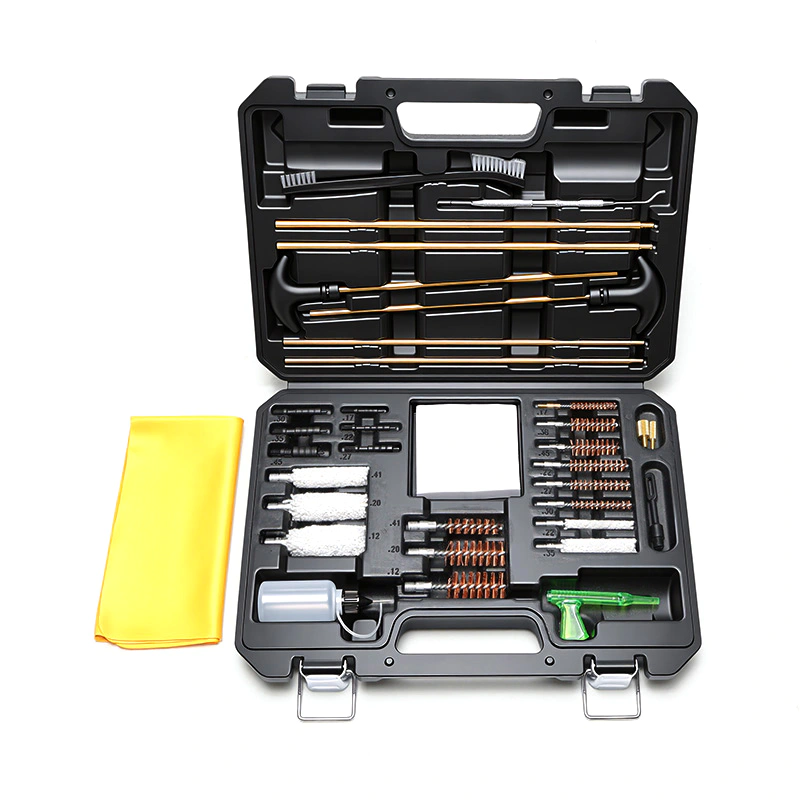
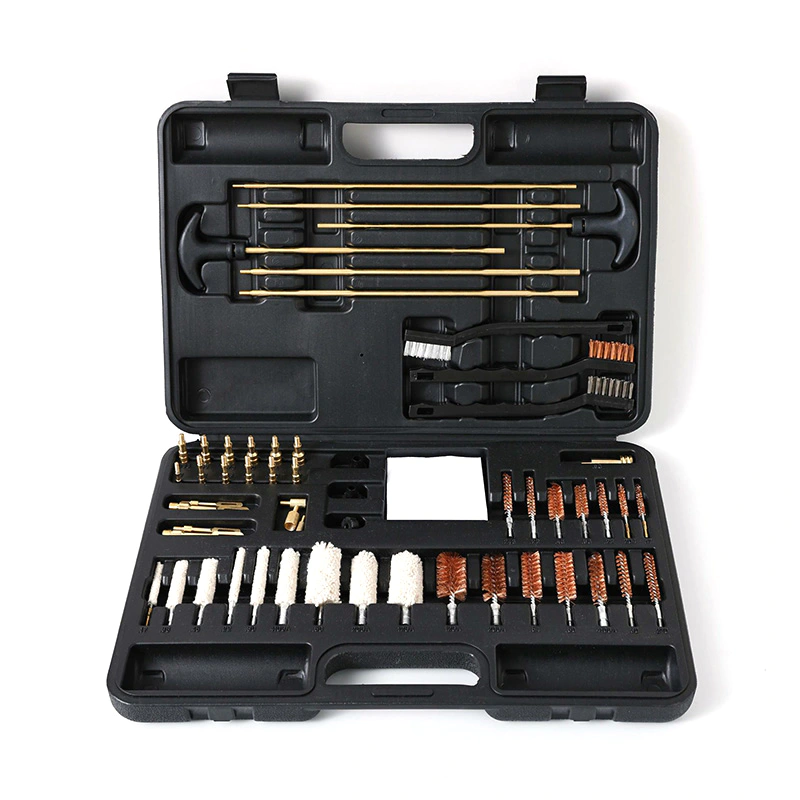
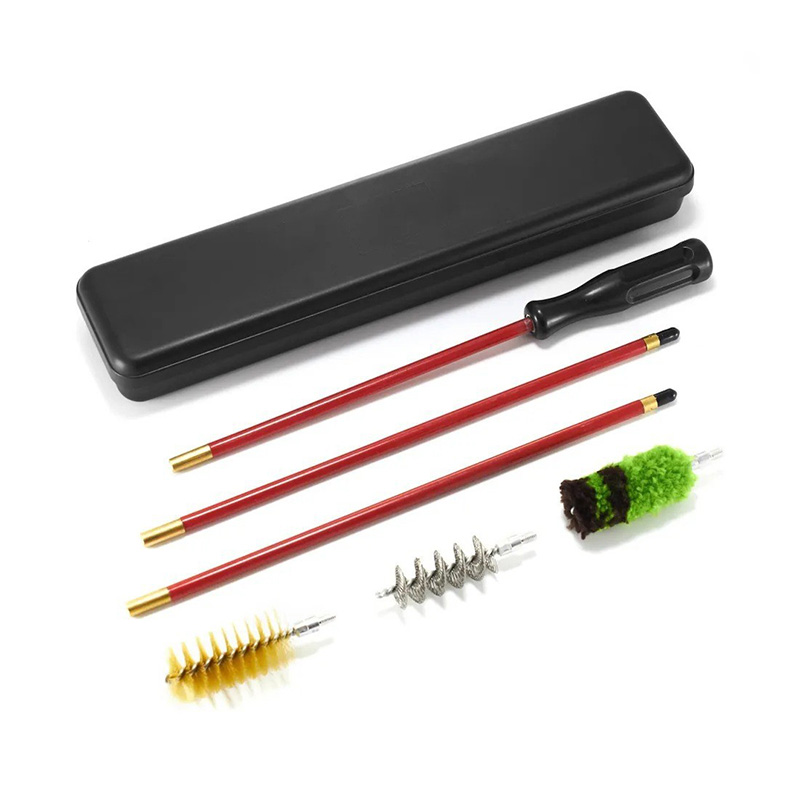
The Gun Cleaning Brush & Tool Kit is designed around these practical requirements. It combines an extended cleaning rod, multiple brush types, dual-ended cleaning tools, and a durable zipper storage pouch in one organized system. Its enhanced brush heads feature increased bristle density, allowing users to clean more surface area with each pass. The result is a more efficient maintenance process compared with basic cleaning sets that use sparse or inconsistent bristles.
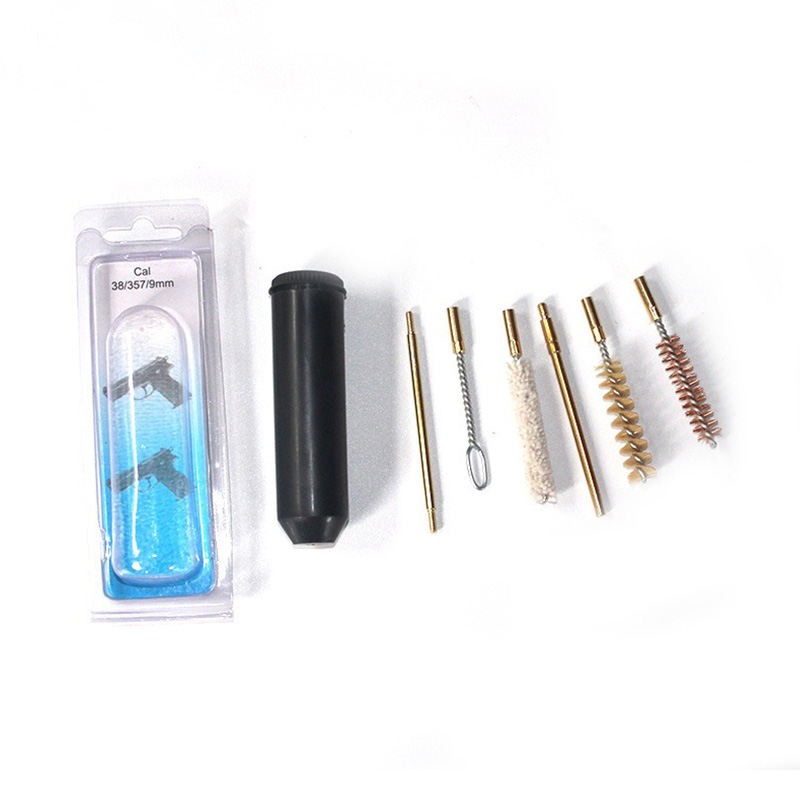
The kit is suitable for a range of firearm maintenance applications, including long-barrel rifles, shotguns, and selected handgun calibres when the appropriate specification is chosen. Available configurations include 12GA, .223/5.5 calibre, and .38/9mm calibre options. The assembled rod can reach a maximum length of approximately 870 millimetres, offering useful reach for long-barrel applications and field cleaning situations.
Manufactured by an experienced tool factory in Jinhua, Zhejiang, the product benefits from established production systems, quality-control procedures, and OEM and ODM capabilities. The manufacturer has operated since 1999 and supplies customers in more than 50 countries and regions. Its production strength supports wholesale orders, private-label programs, customized packaging, and branded product development.
Firearm fouling is created by several different sources. Combustion produces powder residue and carbon deposits. Bullet movement may leave copper or other metallic traces in the bore. Dust, oil residue, and environmental contaminants can accumulate during storage, transport, and use. If these materials are not removed, they may interfere with reliable operation, contribute to corrosion, or gradually reduce cleaning efficiency.
A single brush is rarely sufficient for complete maintenance. A bore requires a tool that can travel through its length, while chambers, locking areas, feed components, and exterior surfaces often require smaller or differently shaped brushes. Soft cloths and patches are useful for wiping and polishing, while metallic or nylon bristles are better suited to loosening deposits in selected areas.
A complete kit reduces the need to purchase these items separately. It also ensures that the components are compatible, conveniently stored, and available whenever maintenance is required. For retailers, a complete set is easier to present as a practical solution rather than as a collection of unrelated accessories. For end users, it simplifies the process of selecting a brush, rod, and cleaning implement for each stage of maintenance.
The Gun Cleaning Brush & Tool Kit is particularly useful because it combines reach, brush variety, portability, and customization potential. Its design addresses the most common weaknesses found in entry-level cleaning sets: low brush density, limited rod length, poor storage organization, and insufficient product differentiation.
One of the main improvements in this kit is the increased bristle density on the brush heads. Bristle density directly affects how much contact a brush makes with a surface during each stroke. A brush with widely spaced bristles may require repeated passes to reach the same cleaning result, while a denser brush can engage more residue during each movement.
In the bore, increased contact helps loosen carbon fouling, powder residue, and copper deposits. The bristles reach into surface irregularities and provide consistent mechanical action as the brush travels through the barrel. This helps reduce the number of cleaning cycles needed for routine maintenance, particularly after extended use or when residue has begun to harden.
Greater density also contributes to a more even cleaning pattern. Instead of concentrating pressure in a few isolated areas, the brush distributes contact across a larger portion of the bore. This is useful for maintaining a consistent cleaning process and minimizing the temptation to apply excessive force.
The enhanced brush-head design is an important point of difference from basic competitor kits. Many low-cost sets are assembled with lightweight components and sparse bristles primarily to reduce production cost. Although such products may be suitable for occasional light dust removal, they may be less efficient when dealing with stubborn fouling. The denser brush configuration in this kit is intended to provide a more substantial cleaning tool while remaining suitable for regular maintenance.
Brush selection should always match the firearm and the area being cleaned. Metallic brushes are appropriate for certain bore-cleaning tasks when used carefully and according to the firearm manufacturer’s recommendations. Nylon and other non-metallic brushes are useful for gentler cleaning of surfaces where a softer material is preferred. The kit’s combination of brush types supports this distinction and gives users more control over the cleaning process.
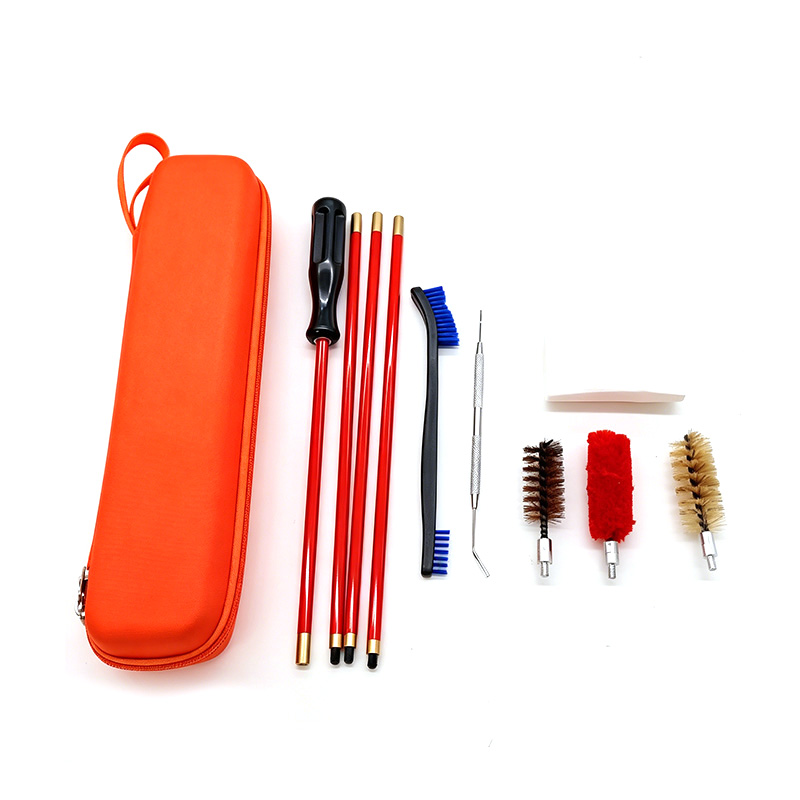
Gun Cleaning Brush & Tool Kit
The cleaning rod is one of the most important components in a bore-cleaning system. A rod that is too short may not reach the full length of a rifle barrel, while a rod with weak construction may flex excessively or feel unstable during use. The product uses an extended red cleaning rod that reaches up to 870 millimetres when assembled.
This length makes the kit suitable for long-barrel rifles and other applications where additional reach is required. It also gives users more flexibility when cleaning in a workshop, at a shooting range, or in the field. The rod can be assembled according to the required working length, allowing the kit to remain compact during storage while providing extended reach during use.
The model is described as a cloth-covered red shaft. The outer covering gives the product a distinctive appearance and supports visual differentiation in a retail environment. It also creates a recognizable product identity for private-label customers that want a cleaning kit with a more distinctive appearance than standard plain-metal or black-plastic alternatives.
A longer rod can improve user posture and handling when cleaning long barrels. It reduces the need to work close to the muzzle and gives the user a more stable grip position. However, proper alignment remains essential. Users should select a suitable guide or adapter when appropriate, keep the rod aligned with the bore, and follow the firearm manufacturer’s maintenance instructions.
The supplied specifications identify a maximum assembled length of 870 millimetres and a configuration that may include a 7-millimetre shaft, steel frame, and double-ended brush. Exact components can vary according to the selected model and calibre. This makes it important for buyers, distributors, and retailers to confirm the intended specification before placing an order.
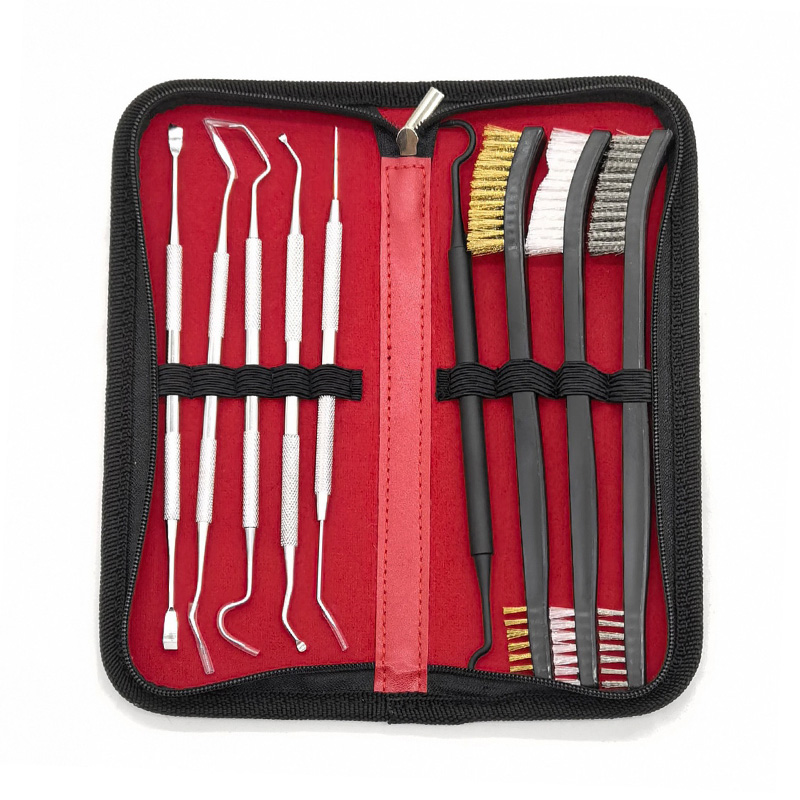
Different firearm surfaces require different cleaning approaches. The Gun Cleaning Brush & Tool Kit includes multiple brush types, including copper or brass wire brushes and dual-head cleaning brushes. These tools allow users to move from bore cleaning to detail cleaning without opening a second equipment case.
Wire brushes are designed to provide firm mechanical action. They can help break up deposits that are difficult to remove with a cloth or soft brush alone. The kit is identified with a copper wire brush type and metal bristle material in the supplied product information. Some specifications also refer to tungsten wire, so the exact bristle composition should be verified for each variant before purchase or distribution.
Dual-ended brushes provide two cleaning ends in one compact tool. One end can be used for broader surface contact, while the other can reach smaller recesses and narrow areas. This format is practical for cleaning around action components, grooves, corners, and other areas that are difficult to access with a large brush.
Non-metallic brush options, including nylon or other material brushes, are also important in a complete firearm maintenance system. They can be used for lighter cleaning, dust removal, and areas where a softer contact material is preferred. A well-rounded kit should enable users to choose between firm and gentle cleaning rather than forcing every task to be completed with the same brush.
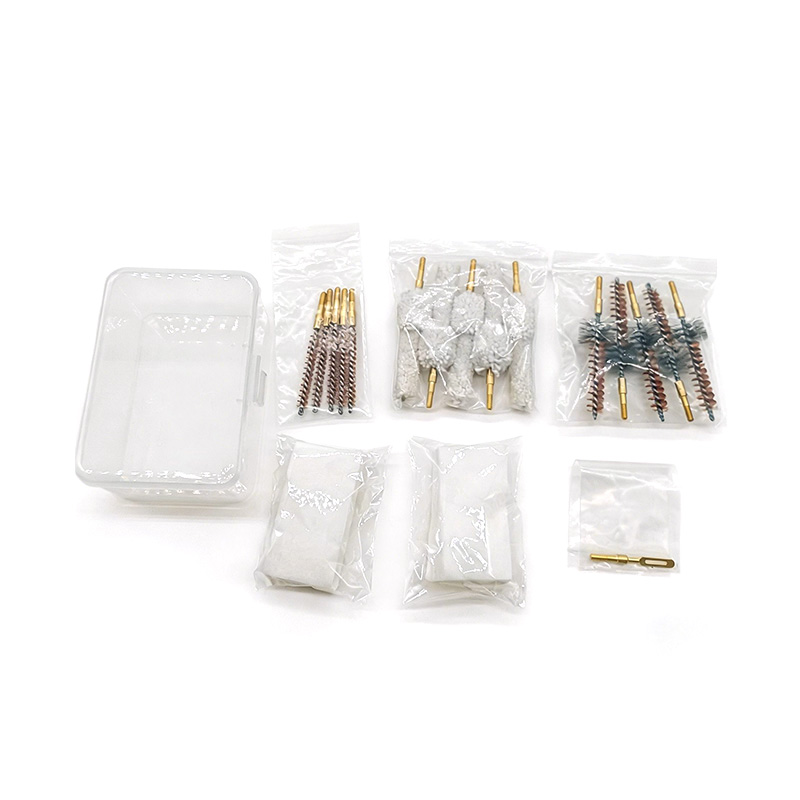
The range of available brush categories also supports product-line expansion. The manufacturer’s broader product portfolio includes bronze and brass brushes, bore mops, nylon brushes, cleaning patches, cleaning cloths, rods, and adapters. Retailers can therefore build a coordinated range around the core kit, offering replacement brushes and specialized accessories to existing customers.
Effective cleaning must be balanced with careful handling. A cleaning tool should remove fouling without unnecessarily damaging the bore or rifling. The design of this kit emphasizes bore-safe use through suitable brush configurations, a guided cleaning approach, and compatibility with different cleaning accessories.
Users should select the correct calibre version for the firearm being serviced. The available specifications include 12GA, .223/5.5 calibre, and .38/9mm calibre variants. Using an unsuitable brush can reduce cleaning efficiency or create excessive resistance. Retailers should clearly communicate the calibre options so that customers can choose the correct model.
Before cleaning, the firearm must be unloaded and handled in accordance with all applicable safety procedures. The user should consult the firearm manufacturer’s instructions to determine the appropriate cleaning direction, chemicals, lubrication method, and brush type. The cleaning rod should be kept aligned with the bore, and excessive force should be avoided if resistance is encountered.
A bore-safe design does not eliminate the need for responsible technique. It gives the user a better tool for applying that technique. The dense bristles are intended to improve contact and efficiency, not to encourage aggressive scrubbing. Controlled passes, appropriate solvent use, and inspection after cleaning are essential parts of good maintenance.
For distributors, these safety considerations are also important in product documentation and packaging. Clear instructions can reduce misuse, improve customer satisfaction, and support a more professional brand image. OEM customers can incorporate cleaning guidance, calibre information, and maintenance recommendations into customized packaging or instruction materials.
Storage is often overlooked when comparing cleaning kits, yet it has a direct effect on usability. Loose rods and brushes can become separated, damaged, or difficult to locate. A disorganized kit may cause users to select the wrong tool or leave accessories behind after maintenance.
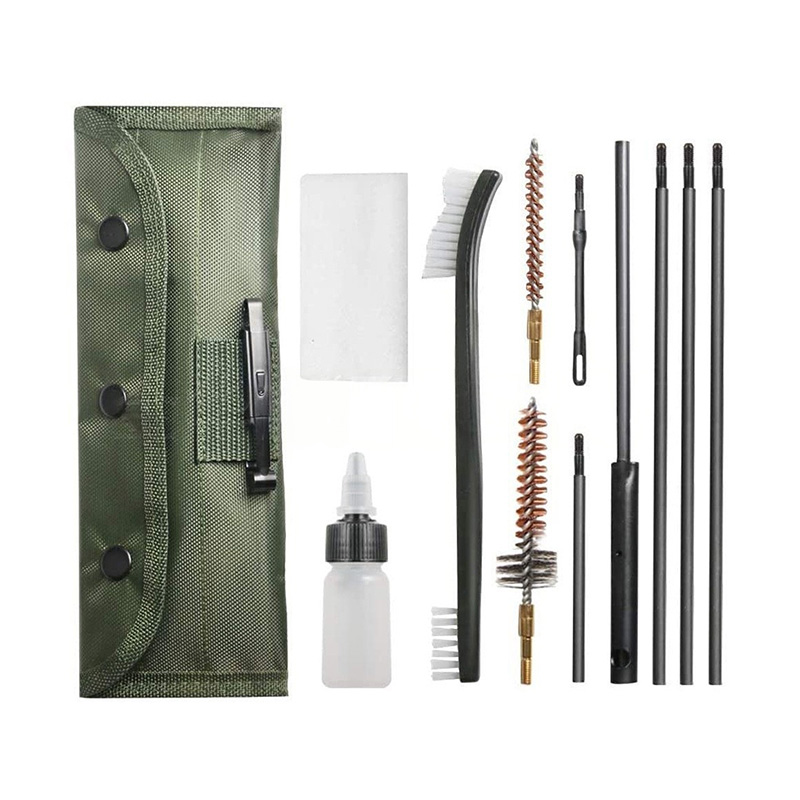
This product includes a durable, wear-resistant zipper storage pouch. The pouch is designed with a structured internal layout that helps keep the components organized and accessible. A zipper closure supports secure transport, while the compact format makes it practical for storage in a range bag, workshop cabinet, vehicle, or equipment case.
The pouch also adds value for retail presentation. A complete cleaning kit in a dedicated case looks more professional than a group of loose tools bundled together. It is easier to display, easier to photograph for online product listings, and more convenient for customers to store after purchase.
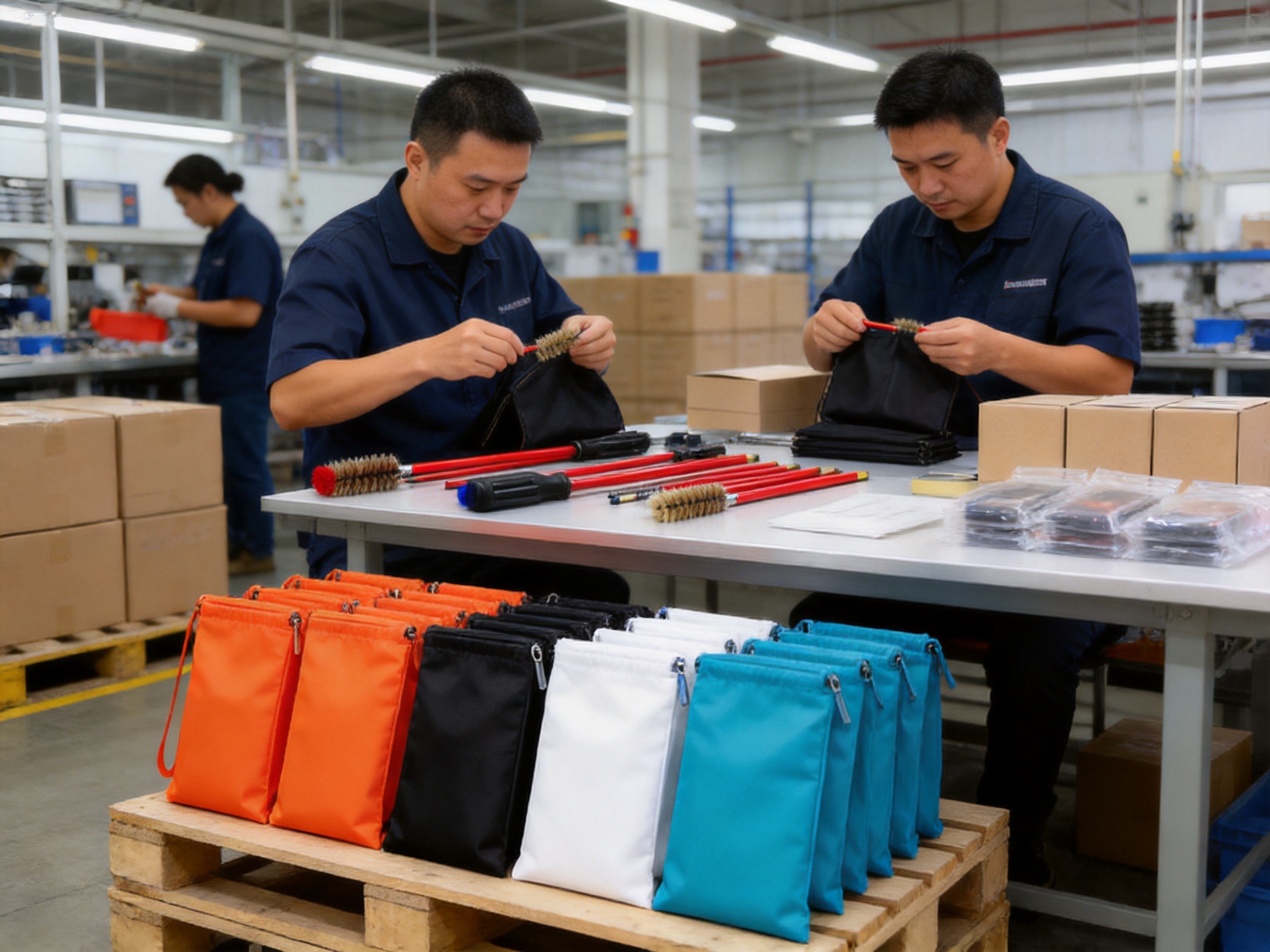
Color options include white, orange, black, and lake blue, with the listed product variant shown with an orange cloth cover. Multiple colors allow sellers to create separate product options, coordinate the kit with an existing product line, or develop distinctive private-label packaging. Color variation can also assist warehouse organization when different calibres or configurations are assigned to different color codes.
For e-commerce sellers, the pouch helps communicate portability and completeness in product images. Customers can see that the kit is designed for transport rather than permanent workshop use only. This is especially valuable for customers who clean firearms at a range, during travel, or in outdoor environments.
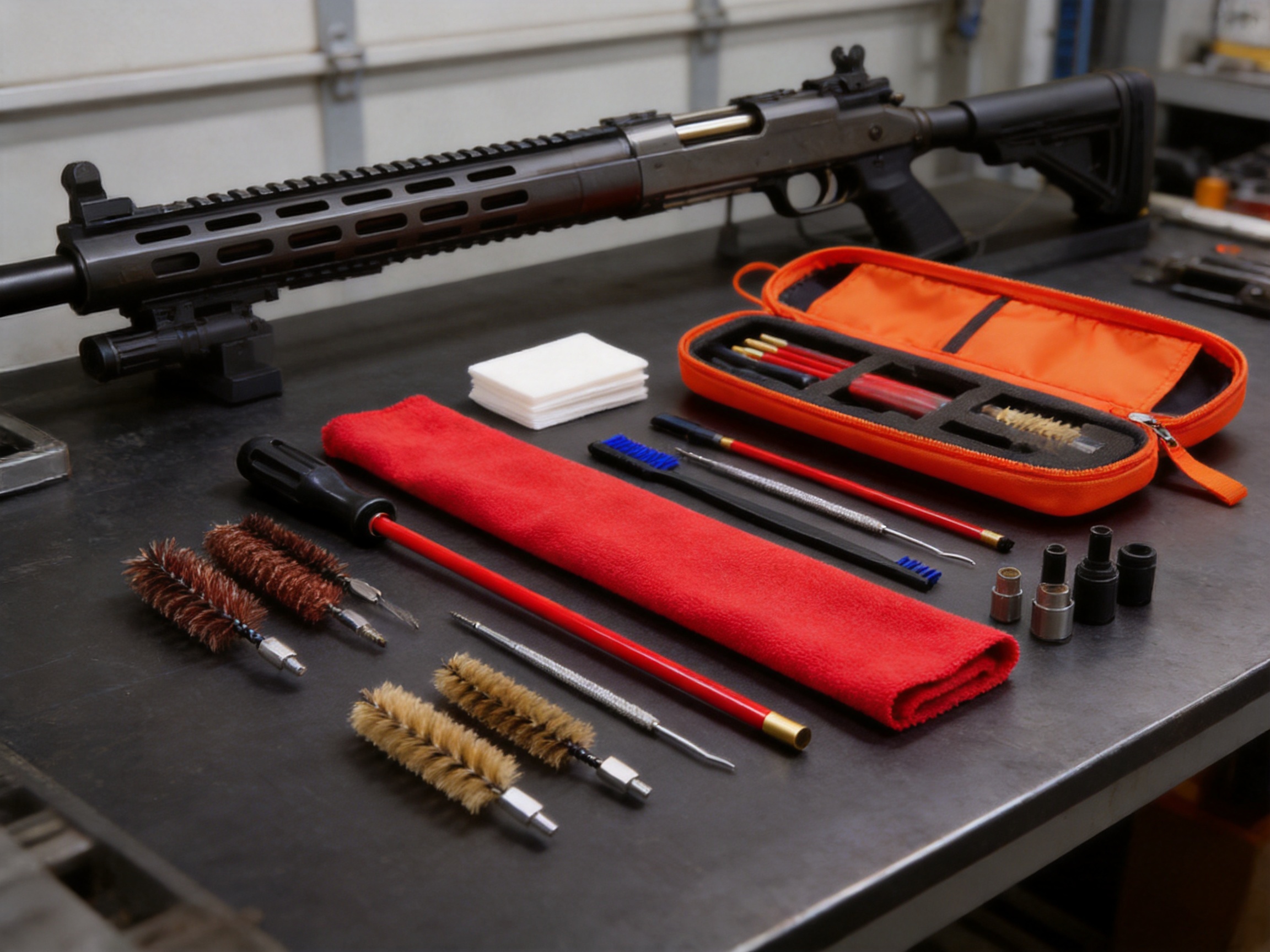
The following table summarizes the main information supplied for the product. Buyers should confirm final dimensions, component counts, bristle materials, and packaging details with the manufacturer for the selected order configuration.
| Product name | Gun Cleaning Brush & Tool Kit |
| Product category | Gun Cleaning Kits |
| Brand | Huntace |
| Product code | #8021 |
| Model description | Cloth-covered red shaft |
| Maximum assembled length | 870 millimetres |
| Listed brush type | Copper wire brush |
| Bristle material information | Metal; selected specifications also refer to tungsten wire |
| Brush shape | Round |
| Primary function | Cleaning and dust removal |
| Available calibre specifications | 12GA; .223/5.5 calibre; .38/9mm calibre |
| Additional configuration | 12GA with 7-millimetre shaft, steel frame, and double-ended brush |
| Storage | Wear-resistant zipper pouch with structured internal layout |
| Color options | White, orange, black, and lake blue |
| Customization | OEM, ODM, private label, packaging, and logo customization available |
| Main downstream platforms | Amazon and AliExpress |
| Origin | Jinhua, Zhejiang, China |
The product code system allows different calibre versions to be identified during ordering and inventory management. The listed #8021 specification is associated with 12GA, while #8022 and #8023 are associated with .223/5.5 calibre and .38/9mm calibre respectively. Buyers should verify whether a different code, accessory combination, or color is required for their market.
The increased bristle density is a meaningful advantage over low-cost sets with lightly populated brush heads. More bristles create broader contact with the fouled surface and can reduce the number of passes required for routine cleaning. This may save time for individual users and improve labor efficiency for professional or high-volume maintenance environments.
Many compact cleaning kits prioritize portability at the expense of rod length. An assembled length of up to 870 millimetres gives this product a stronger position for long-barrel applications. The rod remains transportable because it is stored in sections or in a compact configuration, yet it provides useful reach when assembled.
A basic kit may contain only one rod and one brush. This product combines several brush types and dual-ended cleaning tools, allowing it to address bore cleaning, detail cleaning, dust removal, and general maintenance. Broader tool coverage increases the practical value of the kit and reduces the need to purchase separate accessories.
The structured zipper pouch provides a clear advantage over loose or poorly organized tool bundles. Users can locate each brush quickly and return it to the correct position after use. For online retailers, the pouch also supports a stronger value proposition because the product is presented as a complete maintenance system.
Many competing products are available only as fixed retail items. This kit supports OEM and ODM customization, including product appearance, color selection, logos, packaging, and private-label presentation. That flexibility helps importers and e-commerce sellers create a differentiated product rather than competing solely on price.
The manufacturer’s long operating history, modern production facility, and semi-automatic and fully automated systems support consistent output. Stable manufacturing is particularly important for wholesale customers who require repeat orders with consistent dimensions, colors, packaging, and performance characteristics.
The product is manufactured by Jinhua Tongshun Tool Factory, a comprehensive enterprise integrating research and development, production, and sales. Established in 1999, the company has more than 26 years of experience in gun cleaning kits, barrel cleaning brushes, and related firearm maintenance accessories.
This experience provides a strong foundation for product development. Cleaning tools must balance material selection, brush geometry, shaft construction, usability, packaging, and cost. A factory with long-term specialization in this category is better positioned to understand these relationships than a general-purpose supplier with limited experience in firearm maintenance products.
The company operates a modern production facility with semi-automatic and fully automated production systems. Automation can improve repeatability in processes such as assembly, component placement, brush attachment, and packaging preparation. Semi-automatic operations allow production teams to maintain flexibility for different models, colors, and custom specifications.
A combination of automation and skilled production personnel is valuable for OEM and ODM work. Standardized processes help maintain consistent product quality, while adaptable production lines make it easier to accommodate customized packaging, logos, and product combinations. This balance is especially useful for buyers who require an initial sample, a pilot order, and then larger repeat shipments.
Quality control is another central manufacturing strength. Consistent brush density, secure component attachment, acceptable shaft alignment, reliable zipper function, and accurate packaging all contribute to customer satisfaction. Quality inspection should cover incoming materials, in-process assembly, finished products, and shipment preparation. A systematic approach helps identify defects before products reach distributors or consumers.
The factory’s export experience also supports international business requirements. Products are exported to more than 50 countries and regions, giving the company experience with overseas buyers, product specifications, packaging expectations, and cross-border supply arrangements. This international orientation is useful for e-commerce brands and distributors that need a supplier familiar with export-oriented production.
The kit is suitable for sellers who want more than a standard catalog product. OEM customers can request their own logo, packaging design, color combination, product labeling, and market-specific presentation. ODM customers may work with the factory to adjust the product configuration or develop a related cleaning tool based on their target market.
Private-label customization provides several commercial benefits. A unique product identity makes it easier to establish brand recognition and reduces direct comparison with generic listings. Customized packaging can explain the intended calibre, include maintenance instructions, communicate safety information, and present the product in a way that matches the seller’s broader brand.
Color selection is another practical customization tool. White, orange, black, and lake blue options can be assigned to different product variants or used to create a consistent visual identity. For example, a seller may use one color for a shotgun kit and another for a rifle kit, provided the labeling clearly identifies the technical specification.
Customized bundles can also be developed around customer requirements. A buyer may request a specific combination of brass or bronze brushes, nylon brushes, bore mops, patches, cleaning cloths, rods, and adapters. The factory’s broader category expertise makes it possible to discuss a coordinated accessory program rather than sourcing every component from a different supplier.
Before mass production, professional buyers should confirm sample approval procedures, minimum order quantities, lead times, packaging dimensions, logo artwork, color standards, material specifications, inspection requirements, and shipping marks. These details reduce the risk of confusion and help establish a clear production standard.
The kit can be positioned as an essential maintenance accessory for firearm owners, shooting clubs, outdoor equipment retailers, sporting-goods distributors, gunsmithing suppliers, and e-commerce stores. Its broad utility makes it suitable for both first-time buyers who want a complete solution and experienced users who need a replacement or travel kit.
For physical retailers, the pouch allows the product to be displayed as a compact boxed or bagged accessory. The color options can create visual variety on shelves. Retail staff can explain the differences between calibre variants and emphasize the extended rod, dense brush heads, multiple cleaning tools, and organized storage.
For online retailers, the product supports several strong listing themes. Product pages can focus on complete kit convenience, extended reach, enhanced bristle density, portability, and OEM-quality presentation. High-resolution images should show the kit closed, opened, fully arranged, and in close-up views of the brush heads and rod connections.
Marketplace sellers should provide accurate information about calibre compatibility. The product should not be presented as a universal kit unless the selected configuration genuinely supports that claim. Clear variant naming helps reduce returns and increases customer confidence. Sellers should also explain that firearm cleaning should be performed only with the firearm unloaded and in accordance with applicable safety requirements.
Wholesale customers may benefit from a coordinated product family. The main kit can serve as the flagship item, while individual bronze or brass brushes, nylon brushes, bore mops, patches, cloths, rods, and adapters can be sold as replacement or specialized accessories. This approach supports repeat purchases and allows retailers to serve customers with different maintenance preferences.
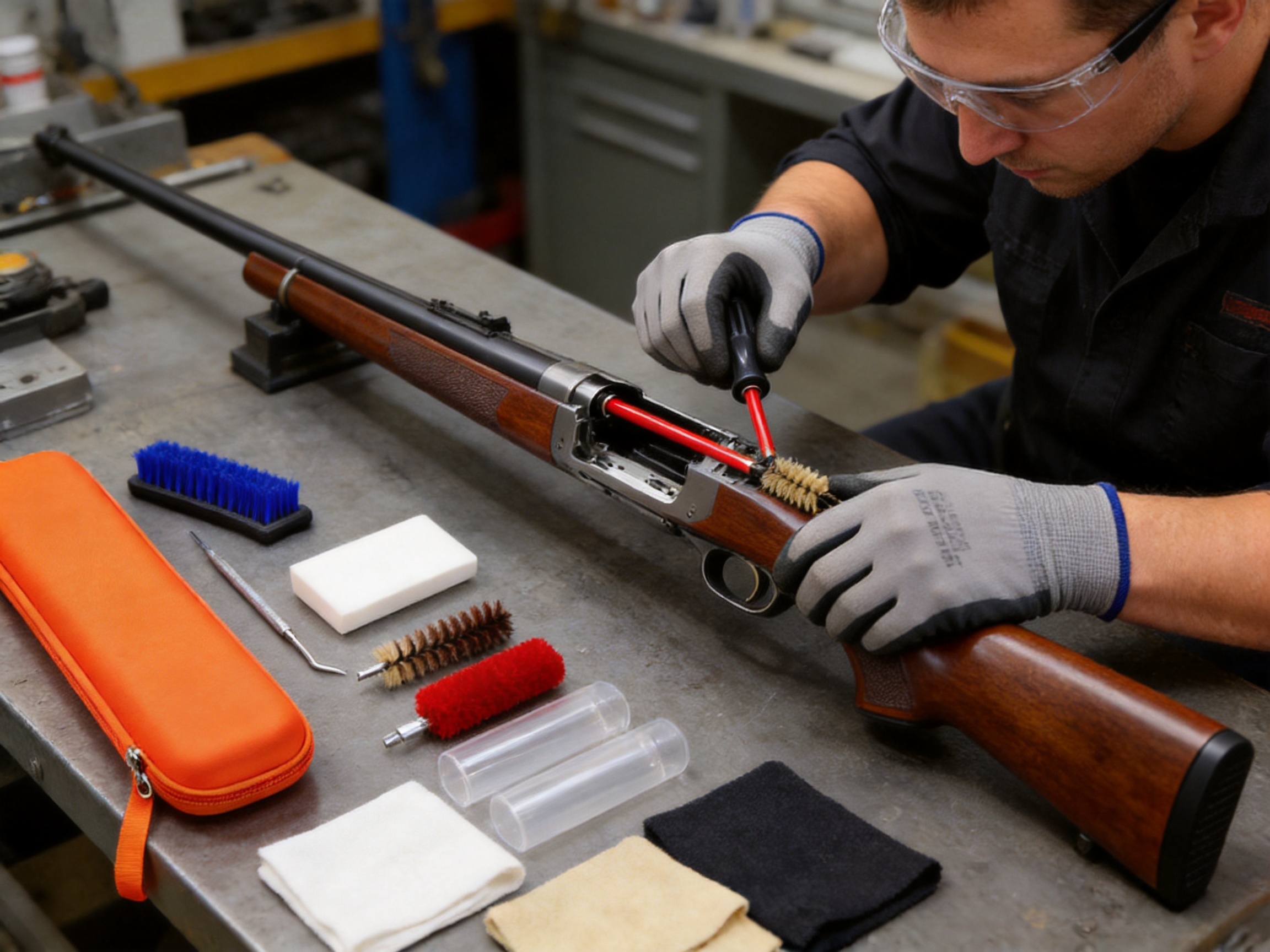
A cleaning kit is most effective when used as part of a consistent maintenance process. The exact procedure varies according to firearm type and manufacturer instructions, but the general workflow can include preparation, inspection, brushing, wiping, drying, and light lubrication where appropriate.
Before beginning, the user should unload the firearm completely, remove ammunition from the immediate work area, and confirm the firearm’s condition according to established safety procedures. The work surface should be stable, adequately lit, and protected from cleaning chemicals. The user should consult the firearm’s manual for disassembly instructions and any restrictions on solvents or brushes.
Inspecting the bore and accessible components helps identify the level and type of fouling. Light dust may require only a soft brush or cloth, while heavier carbon and metallic deposits may require a suitable bore brush and cleaning solvent. Inspection also helps the user select the correct brush and avoid unnecessary force.
The cleaning rod can be assembled to the required length, up to approximately 870 millimetres. Connections should be tightened securely but not over-tightened. The brush or other accessory should be attached firmly, and the user should verify that the selected tool corresponds to the firearm’s calibre.
The brush should be guided through the bore with steady, controlled movements. The rod should remain aligned with the bore, and the user should avoid forcing the tool through areas of unusual resistance. Increased bristle density is intended to improve contact and cleaning efficiency, allowing the user to rely on controlled passes rather than excessive pressure.
After brushing, patches, cloths, or other appropriate accessories can be used to remove loosened residue and excess cleaning solution. The bore and other cleaned areas should be inspected before the firearm is reassembled or stored. Any remaining moisture should be addressed according to the firearm manufacturer’s instructions.
This workflow demonstrates why a complete kit is more useful than an isolated brush. Each stage requires a different type of tool, and the organized pouch keeps those tools together for efficient maintenance.
Material selection influences the performance and service life of cleaning tools. Metal bristles provide a firm cleaning action for suitable applications, while nylon and other non-metallic materials offer a gentler alternative for selected surfaces. Shaft materials must provide adequate strength and connection reliability, while the cloth covering contributes to the product’s appearance and differentiation.
The pouch is made from a wear-resistant material selected for repeated handling and transport. Its zipper and internal structure are important functional details because a storage case must survive routine opening, closing, movement, and storage. A durable pouch also protects the brushes from becoming scattered or contaminated between uses.
For brands, visual presentation can be nearly as important as technical specifications. The red shaft and available pouch colors help the product stand out in photographs and retail displays. A clear color system, professional logo application, and organized packaging can make the kit appear more valuable and improve its suitability for premium or mid-market positioning.
Product presentation should remain accurate. Claims should be based on the selected configuration and verified specifications. Retail content should distinguish between included components and optional accessories, identify calibre versions, and explain that exact dimensions may vary by model. Accurate presentation protects both the seller and the customer.
Wholesale buyers typically need more than a competitive unit price. They require reliable production, consistent quality, clear communication, suitable packaging, and the ability to replenish inventory. The manufacturer’s experience in large-scale production and international export supports these requirements.
Consistent production capacity helps reduce stock interruptions. When a retailer invests in product photography, listing content, advertising, and customer education, an unavailable product can create significant commercial disruption. A supplier with established manufacturing systems is better equipped to support repeat orders and planned inventory cycles.
Quality consistency is also important when products are sold under a private label. A customer expects the second order to match the first in appearance, fit, brush density, and packaging. Production standards, approved samples, and inspection procedures help maintain this consistency.
The factory’s integration of research and development, production, and sales can simplify communication. Instead of sending requirements to separate design, assembly, and packaging companies, a buyer can discuss the product program with one specialized manufacturer. This may reduce coordination time and make it easier to implement design adjustments.
International customers can also benefit from the company’s experience with cross-border export products. The supplied information identifies Amazon and AliExpress among the main downstream platforms and indicates that the products are intended for cross-border export supply. This aligns well with online sellers that need retail-ready products for international markets.
The first selection factor is calibre. The listed variants include 12GA, .223/5.5 calibre, and .38/9mm calibre. Buyers should match the kit to the intended firearm and verify the measurement system used in their market. If a customer services several firearm types, a multi-kit purchase or a coordinated accessory range may be more appropriate than relying on one configuration.
The second factor is the intended application. Long-barrel rifle users may place greater emphasis on the 870-millimetre maximum rod length. Users seeking a compact travel solution may prioritize pouch size and component organization. Retailers should identify the primary use case in their product descriptions.
The third factor is brush material. Metal brushes provide a firmer cleaning action for suitable tasks, while nylon or other non-metallic options may be preferred for more delicate cleaning. Retailers should avoid suggesting that one material is suitable for every surface or firearm.
The fourth factor is branding and packaging. Sellers should decide whether they need a standard color, a customized pouch, printed packaging, a private label, or a complete OEM program. Early confirmation of these requirements helps the factory provide an accurate quotation and production schedule.
Finally, buyers should confirm the contents of each variant. The product information refers to model numbers, brush types, a steel frame, a 7-millimetre shaft in one configuration, and double-ended brush components. Because accessory combinations may differ, a written component list should be approved before the order is finalized.
The kit is designed to include an extended cleaning rod, multiple brush types, brass or copper wire brush components, dual-ended cleaning tools, and a zipper storage pouch. The exact component combination depends on the selected calibre and model. Buyers should request a final packing list for the specific variant.
The maximum assembled length is approximately 870 millimetres. This extended length makes the kit suitable for many long-barrel cleaning applications while allowing the rod to be stored in a more compact configuration.
The listed specifications include 12GA, .223/5.5 calibre, and .38/9mm calibre versions. The correct option must be selected according to the firearm being serviced. The model numbers and included accessories should be confirmed before ordering.
The product information identifies multiple brush types and the manufacturer’s broader range includes nylon and other material brushes. Whether nylon brushes are included in a particular kit depends on the chosen configuration. Buyers can discuss customized brush combinations with the manufacturer.
No cleaning kit should be treated as universally suitable without checking the firearm manufacturer’s instructions. Users must select the correct calibre, use appropriate brush materials, keep the rod aligned, and avoid excessive force. The kit provides versatile tools, but responsible selection and technique remain essential.
Yes. The maximum assembled rod length of 870 millimetres is intended to provide useful reach for long-barrel applications. Users should still confirm that the selected brush and accessory configuration matches the specific rifle.
The brush heads feature increased bristle density. This creates broader contact with the bore and can improve the removal of carbon fouling, powder residue, and copper deposits. The denser construction is intended to make routine cleaning more efficient than cleaning sets with sparse bristles.
All tools are organized in a durable, wear-resistant zipper pouch with a structured internal layout. The pouch helps protect the components during transport and makes individual brushes and accessories easier to locate.
Available color options include white, orange, black, and lake blue. The supplied product variant is described with an orange cloth cover. Color availability should be confirmed for the selected order quantity and customization program.
Yes. OEM and ODM services are available, including customized products, packaging, logos, and private-label presentation. Buyers should confirm minimum order quantities, artwork requirements, color standards, samples, and production schedules before placing a customized order.
The product is manufactured by Jinhua Tongshun Tool Factory in Jinhua, Zhejiang Province, China. The company was established in 1999 and specializes in gun cleaning kits, barrel brushes, and related firearm maintenance accessories.
Yes. The factory operates semi-automatic and fully automated production systems and provides OEM and ODM services for international customers. Its products are exported to more than 50 countries and regions, supporting wholesale and cross-border e-commerce supply.
Yes. The manufacturer’s product categories include bronze and brass brushes, nylon brushes, bore mops, cleaning rods and adapters, patches, and cleaning cloths. Buyers can discuss coordinated bundles or related accessory programs based on their market requirements.
The Gun Cleaning Brush & Tool Kit combines several practical advantages in one maintenance solution. Its enhanced bristle density supports more efficient cleaning, while the extended rod provides a maximum assembled reach of approximately 870 millimetres for long-barrel applications. Multiple brush types and dual-ended tools give users greater flexibility, and the structured zipper pouch keeps the equipment organized and transportable.
Compared with basic competitor sets, the product offers stronger tool coverage, improved brush contact, longer working reach, more professional storage, and greater visual differentiation. Its calibre options and color choices make it suitable for varied retail strategies, while OEM, ODM, and private-label support allow importers and e-commerce sellers to develop customized product lines.
The manufacturer adds further value through more than 26 years of specialized experience, integrated research and development, semi-automatic and fully automated production systems, export capability, and quality-control processes. These strengths make the product suitable not only for individual firearm owners but also for retailers, distributors, shooting-sports suppliers, and international online brands.
For the best results, buyers should confirm the exact brush materials, accessory list, calibre, dimensions, packaging, color, and customization requirements for each order. With the correct configuration and responsible use, this kit provides a practical foundation for regular firearm maintenance and a strong platform for a differentiated wholesale or private-label offering.
1. Manufacturer-supplied product specifications for the Gun Cleaning Brush & Tool Kit, including model numbers, calibre variants, rod length, brush materials, colors, and customization information.
2. Manufacturer-supplied company profile for Jinhua Tongshun Tool Factory, including establishment date, production capabilities, export experience, and OEM and ODM services.
3. General firearm maintenance principles concerning unloaded-firearm handling, appropriate tool selection, bore alignment, controlled brushing, and following the firearm manufacturer’s instructions.
4. General product-design considerations for cleaning brushes, including bristle density, material selection, storage organization, shaft reach, and accessory compatibility.
5. General wholesale and private-label procurement practices concerning sample approval, component lists, packaging specifications, inspection standards, and repeat-order consistency.